
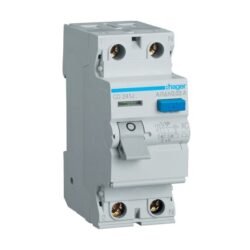
DP-Double Pole
Showing the single result
A Double Pole RCCB (DP RCCB) is the most widely used earth leakage protection device in Indian single-phase residential and light commercial electrical installations. It simultaneously disconnects both the Live and Neutral wires the instant a leakage current is detected — protecting people from electric shock and preventing electrical fires. Elecload stocks DP RCCBs from India’s top brands in current ratings of 25A, 40A, and 63A and sensitivity ratings of 30mA and 100mA — all IS 12640-1 certified, GST-compliant under HSN Code 8536, and priced well below MRP. Whether you are wiring a flat, a shop, or a distribution board, you will find the right DP RCCB here.
Double Pole RCCB – The Complete Buyer’s Guide for India
There is one device that every licensed electrician in India installs without being asked — the RCCB. And for single-phase circuits in homes, apartments, shops, and small offices, the Double Pole (DP) RCCB is the standard choice. It sits in your distribution board, silently monitors the difference between the current flowing in and the current flowing out, and the moment it detects even a tiny imbalance — caused by a person touching a live wire, a damaged appliance leaking current, or a faulty connection — it trips the circuit in milliseconds. That speed is what makes it life-saving.
At Elecload, we stock DP RCCBs from India’s most trusted switchgear brands — Havells, Schneider Electric, Legrand, ABB, Siemens, and others — in all standard ratings used in Indian installations. Every product is IS 12640-1 certified, comes with a valid GST invoice under HSN Code 8536, and is priced at a genuine discount from MRP.
Why a Double Pole RCCB and Not a Single Pole or Four Pole?
This is a question that comes up constantly on Indian job sites, and the answer is straightforward. A Single Pole RCCB only disconnects the Live wire — leaving the Neutral connected. In a correctly wired system that is fine, but Indian site wiring is not always correct. Reversed polarity, improper neutral connections, and earth faults on the neutral side are real-world problems. A Double Pole RCCB disconnects both Live and Neutral simultaneously, eliminating any ambiguity and ensuring complete isolation every time it trips.
A Four Pole RCCB is used for three-phase circuits — industrial equipment, large commercial buildings, and three-phase distribution boards. For standard single-phase residential and light commercial work, a DP RCCB is the correct and code-compliant choice.
Frequently Asked Questions – Double Pole RCCB
Q1. What is a Double Pole RCCB and how does it work?
A Double Pole RCCB (also written as DP RCCB or 2-Pole RCCB) is a Residual Current Circuit Breaker with two poles — one for the Live wire and one for the Neutral wire. It works by continuously comparing the current flowing through the Live conductor with the current returning through the Neutral conductor. Under normal conditions, these two values are equal. The moment a fault occurs — such as a person receiving a shock or a damaged cable leaking current to earth — the returning current becomes slightly lower than the outgoing current. This difference, called residual or leakage current, is detected by the RCCB’s internal toroidal transformer. If the leakage exceeds the device’s rated sensitivity (30mA or 100mA), the RCCB trips both poles simultaneously within 25 to 40 milliseconds — fast enough to prevent a fatal electric shock.
Q2. What is the difference between 30mA and 100mA sensitivity in a DP RCCB?
The sensitivity rating tells you the minimum leakage current at which the RCCB will trip. A 30mA RCCB trips when it detects a leakage of 30 milliamperes or more. This is the standard for personal protection — the threshold below which a leakage current is generally considered non-lethal under most exposure conditions. A 100mA RCCB trips only when leakage reaches 100 milliamperes, making it more suitable for fire protection rather than direct shock protection. In Indian residential wiring, 30mA is the correct and most commonly specified sensitivity for all circuits where a person could come into contact with live parts — power sockets, kitchen circuits, bathroom circuits, and outdoor circuits. 100mA units are used in some commercial and industrial applications where nuisance tripping from equipment leakage is a concern and the shock risk is managed separately.
Q3. What current rating of DP RCCB should I use — 25A, 40A, or 63A?
The current rating of a DP RCCB must be equal to or higher than the rating of the main MCB or the maximum load current of the circuit it protects. For a standard Indian single-phase domestic connection with a 32A main MCB, a 40A DP RCCB is the typical choice. For smaller sub-circuits or individual rooms with lighter loads, a 25A RCCB is commonly used. For heavier single-phase loads such as large shop circuits, small commercial premises, or a flat with a 63A incoming supply, a 63A RCCB is appropriate. A simple rule: always select the RCCB rating at or above the upstream MCB rating — never below.
Q4. What is the difference between an RCCB and an ELCB?
You will often see both terms used in Indian electrical practice, sometimes interchangeably, and this creates genuine confusion. Technically, an ELCB (Earth Leakage Circuit Breaker) refers to an older voltage-operated device that detects a voltage difference between the earth wire and a reference point. This technology is now largely obsolete. A modern RCCB (Residual Current Circuit Breaker) is a current-operated device that works as described above — monitoring current balance between Live and Neutral. The modern RCCB is superior in every practical way: it works even when the earth connection is poor or absent, it is faster, and it is the device specified in current Indian standards. When someone in India says “ELCB” today, they almost always mean a current-operated RCCB.
Q5. Can a DP RCCB protect against short circuits and overloads?
No — and this is a critically important point that even some electricians misunderstand. An RCCB protects only against earth leakage current and electric shock. It does not provide overload protection or short circuit protection. For those, you need an MCB (Miniature Circuit Breaker). This is why in a correctly designed distribution board, an RCCB and an MCB are always used together — the RCCB handles earth fault protection and the MCB handles overload and short circuit protection. An RCBO (Residual Current Circuit Breaker with Overcurrent protection) combines both functions in a single device, which is increasingly popular in modern Indian panel designs.
Q6. Which brands of DP RCCB are available on Elecload?
Elecload stocks Double Pole RCCBs from the most trusted names in Indian and global switchgear — including Havells, Schneider Electric, Legrand, ABB, Siemens, Hager, IndoAsian, and GM. Each brand offers slightly different form factors, breaking capacities, and price points, but all products listed on Elecload are IS 12640-1 certified and sourced through authorised supply channels. For residential use, Havells and Schneider are the most commonly specified. For premium commercial installations, Legrand and ABB are popular choices. All come with valid manufacturer warranties.
Q7. What is IS 12640-1 and why does it matter when buying an RCCB in India?
IS 12640-1 is the Bureau of Indian Standards (BIS) certification standard for Residual Current Operated Circuit Breakers without integral overcurrent protection (RCCBs) for household and similar uses. A DP RCCB carrying IS 12640-1 certification has been tested for correct tripping performance, dielectric strength, mechanical endurance, and temperature limits by a BIS-accredited laboratory. Buying an uncertified RCCB — often cheaper, often sold loose in local markets — is a serious risk. It may not trip at the correct leakage current, may trip too slowly to prevent a fatal shock, or may fail entirely under fault conditions. Always insist on IS 12640-1 certified products, which every DP RCCB on Elecload carries.
Q8. What is HSN Code 8536 and how does it help contractors with GST?
HSN Code 8536 covers “Electrical apparatus for switching or protecting electrical circuits, for a voltage not exceeding 1000V” — the classification under which RCCBs, MCBs, and similar switchgear are taxed in India’s GST system. All DP RCCB purchases from Elecload are invoiced with HSN 8536, making them fully compliant for Input Tax Credit (ITC) claims. For electrical contractors, builders, and businesses purchasing RCCBs for project installations, having the correct HSN code on every invoice is essential for clean ITC claims when filing GST returns.
Q9. Where exactly is a Double Pole RCCB installed in a distribution board?
In a standard Indian residential distribution board (DB), the DP RCCB is typically installed immediately after the main incoming MCB or isolator, before the individual outgoing MCBs for each circuit. This arrangement — called a whole-board RCCB configuration — means a single RCCB protects all circuits in the board simultaneously. In more advanced DB designs, individual RCCBs or RCBOs are installed per circuit, providing selective protection so that a fault on one circuit does not trip the entire board. The choice between whole-board and per-circuit protection depends on the project specification, budget, and the client’s preference for convenience versus selectivity.
Q10. Does Elecload offer bulk pricing on DP RCCBs for contractors and panel builders?
Yes. Contractors, panel builders, electricians, and project procurement teams buying DP RCCBs in bulk — whether for a housing society, commercial complex, hospital, or industrial facility — can use Elecload’s dedicated Bulk Buying programme. Bulk orders for switchgear including RCCBs receive additional pricing negotiation beyond the already-discounted listed prices, along with commercial GST invoices and priority dispatch. Submit a Bulk Quote request through the website or call the team at +91 91378 44532 available 24/7.
