

No products in the cart.
Cable Gland: Types, Size Chart, Standards & How to Choose the Right One Leave a comment
Learn what a cable gland is, its types, size chart, Indian standards, and how to choose the right cable gland for safe, reliable electrical installations.
The key to cable entry and protection in electrical systems is as important as the cable itself. A cable gland is critical to the securement of electrical cables, equipment and long-term safety. The right cable gland enhances reliability and prevents electrical failures in a wide range of applications, including control panels, outdoor wiring, and industrial machinery.
Thinking, what is a cable gland? How does it fit? Or wanted to know about its size, the rules in India, and how to choose the right cable gland for different purposes. This article will help you. Let’s get started.
1. What is a Cable Gland
A cable gland is a mechanical device used to securely remove and tie electrical cables when they enter electrical panels, enclosures or equipment. In simple terms, the cable gland meaning is a fitting that holds the cable securely in place while sealing the exit point.
Protection and Cable Safety
The cable is shielded from external stress, dust, moisture, and vibration by an electrical cable gland. This also protects the cable from pulling out or bending abruptly at the entry point, which can damage insulation over time.
Purpose and Functional Importance
The purpose of cable gland is not just for retaining the cable; it provides strain relief, enclosure protection levels, and, for armoured cables, proper earthing. Thus, cable gland use is necessary for a safe electrical system design.
Applications of Cable Glands
A cable gland in electrical panel provides a connection for cables in power lines, motors, pumps, outdoor lighting systems, and other industrial equipment where cable safety and sealing are required.
2. Types of Cable Glands
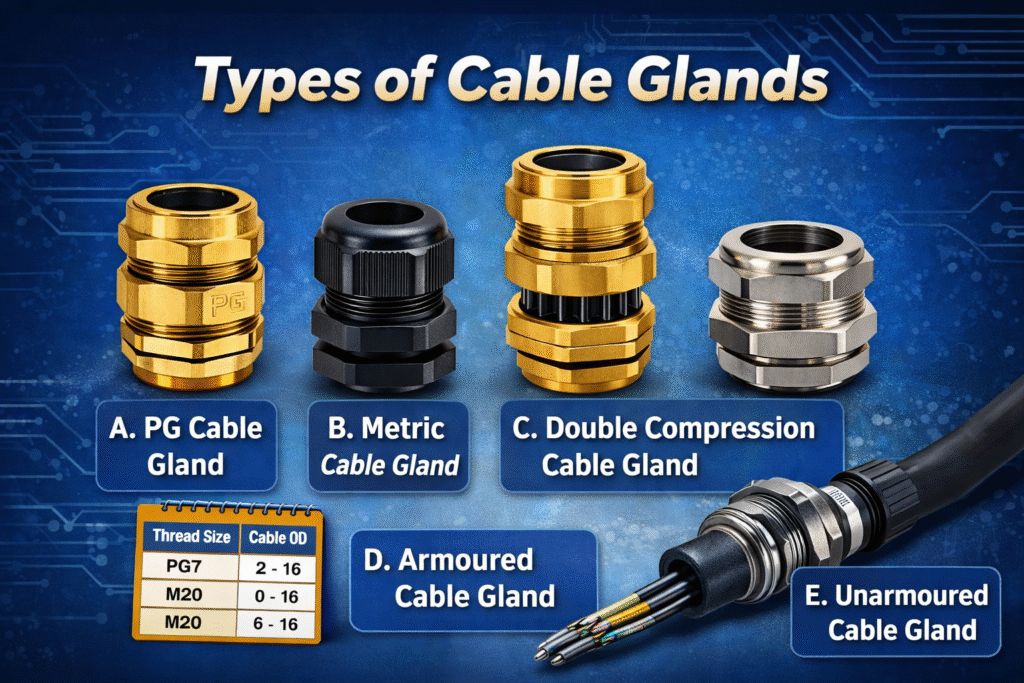
Understanding the types of cable glands can help us to choose the proper gland based on cable type, environment and safety requirements.
A PG cable gland is an older European standard and is still in many old panels. PG sizes are not metric and are given in traditional cable diameter ranges. While PG glands are still in use, they are most commonly used to maintain or replace older installations.
It is the most common and current standard to use a metric cable gland. Millimetre-sized threads can be used more readily for new enclosures and panels. The availability and accurate sizing of metric glands have made them ideal for new electrical installations.
- Double Compression Cable Gland
Sealing is made by a double compression cable gland at two locations: on the outer sheath and on the cable armour. This dual sealing strategy provides greater protection from dust, moisture and mechanical strain. These glands have widespread applications in industrial and outdoor armoured cables.
- Armoured Cable Gland
An armoured cable gland is designed specifically for armoured cables requiring mechanical protection and earthing continuity. These glands are also responsible for the appropriate closure and repositioning of the armour, making them ideal for indoor and outdoor power applications.
- Unarmoured Cable Gland
Light-duty cables do not require armour and have an unarmoured cable gland. These glands are widely used with control cables, flexible cables, and instrumentation wiring in indoor panels.
3. Cable Gland Size Chart
Safety and performance depend on selecting the right size. A wrong-sized gland could cause cables to leak, bad sealing or damage to the cable insulation.
The cable gland size is primarily determined by the OD of the cable. It is important to remember that cable size and gland thread size are different. The sealing range is determined by the cable OD, and the thread size matches the panel hole.
Below is a typical cable gland size chart used for reference:
| Thread Size | Cable OD Range (mm) |
| PG7 | 3 – 6.5 |
| PG9 | 4 – 8 |
| PG11 | 5 – 10 |
| M16 | 4 – 8 |
| M20 | 6-12 |
| M25 | 11-17 |
| M32 | 15-21 |
This cable gland chart can be used for fast cable gland size calculation and helps prevent common installation problems. PG and metric glands are different in thread designs, so the correct standard must be selected according to the enclosure.
4. How to Choose the Right Cable Gland
To ensure proper cable protection, safe installation, and long-term electrical safety, it is important to select the right cable gland. The correct cable type, installation location, material, and thread standard determine the right choice.
Step 1: Identify the Cable Type
The first step in how to choose cable gland is to check if the cable is armoured or unarmoured. Armoured cables require cable glands that are designed for proper armour termination and earthing; unarmoured cables can be mounted with standard glands.
Step 2: Measure the Cable Diameter
Afterwards, measure the outer diameter of the cable and match it to the recommended range from the cable gland selection guide. Correct sizing ensures robust grip, sealing and long-term cable protection.
Step 3: Consider the Installation Location
The selection of glands is critical to the installation environment. Standard protection can be required in the room, but more IP ratings can be demanded outdoors. IP rating is crucial for dust, moisture, and weather protection, especially when selecting the best cable gland for outdoor use.
Step 4: Select the Right Material
The material choice is another one. Brass cable glands are highly regarded in the industrial setting because of their strength and durability. Nylon cable glands are lightweight, corrosion-resistant and suited for use in the home. Stainless steel cable glands are ideal for harsh, chemically demanding or marine applications. Knowing the differences in brass vs nylon cable gland usage helps to make the right decision.
Step 5: Choose the Correct Thread Type
Lastly, find the appropriate thread type for the enclosure or panel. The more traditional metric cable glands are recommended for modern electrical systems, while PG cable glands are frequently used for either maintenance or replacement work in older installations.
5. Cable Gland Standards in India
Industrial cable gland standards are preferred because they produce less risk of electrical faults and longer-term performance in demanding conditions.
Safety, compliance, and reliability depend on cable gland standards in India. These are made and selected according to IS standard cable gland specifications and international safety standards.
India offers standards for cable glands that regulate proper sealing, earthing, and mechanical strength. Cable glands with certification or IS standard are the standard in many industrial, commercial, and infrastructure projects.
Industrial cable gland standards help to protect the glands from electrical failure and provide long-term performance, particularly in demanding environments.
Following cable gland requirements ensures safety, conformity, and reliability. India manufactures and chooses cable glands in accordance with IS specifications and international standards of protection.
Cable gland standards in India ensure proper sealing, earthing, and mechanical strength. Certified and IS standard cable gland products are commonly required in commercial, industrial and road construction.
Industrial cable glands are used because they reduce electrical failure risk, but also provide better performance in rough conditions.
6. Common Cable Gland Installation Mistakes
Cable glands that are not properly installed can cause cable loss, cable damage, and serious electrical safety problems. Knowing these common cable gland installation mistakes will help you enjoy reliable performance and long-term protection.
Common cable gland installation mistakes include:
- Using the wrong cable gland size results in poor sealing or damage to cable insulation.
- Use an armoured cable with an unarmoured cable gland, compromising earthing continuity and overall safety.
- Over-tightening of the gland can damage internal seals as well as decrease the ingress protection (IP rating).
- Under-tightening of the gland causes loosening of the cable and strain.
- No proper earthing, especially in armoured cable glands.
- Improper sealing in the outdoor environment increases the likelihood of intrusion of moisture and dust.
By avoiding these cable gland installation errors, electrical installations can be safer and more durable.
Frequently Asked Questions (FAQs)
What size cable gland do I need?
Measure the cable’s outer diameter and match it with the appropriate range in the cable gland size chart.
What cable gland size do I need?
Measure the cable’s outer diameter and match it to the correct angle in the cable gland size chart.
Can I use a metric gland rather than a PG?
Yes, metric glands are a preferred choice for new installations and have been accepted by most manufacturers.
Are armoured cables required to have double compression glands?
They are recommended for better sealing, earthing, and mechanical protection.
Which cable gland is best for outdoor use?
A high IP rating brass or stainless steel gland is best for outdoor applications.
Final Thoughts
The right cable gland is important to electrical safety, durability and compliance. Electrical engineers and electricians can offer long-term reliability through understanding gland types, sizing, standards, and installation methods.
For electrical accessories and parts, choose trusted solutions available at elecload.com

