
ELCB vs RCCB: Difference, Price Comparison and Which One Should You Choose?
If you have ever visited an electrical shop in India and asked for a device to protect your home from electric shocks, chances are you walked out confused about whether you needed an ELCB or an RCCB. Both devices deal with earth leakage protection. Both look similar from the outside. Both sit inside a distribution board. And yet they work on entirely different principles, offer different levels of protection, and carry very different recommendations under Indian electrical standards. This blog explains the real difference between ELCB and RCCB in plain language, compares their working principles, covers the factors that affect ELCB price and rccb price in the Indian market, and helps you decide which one belongs in your home or project.
At Elecload India, founded by Bhavin Joshi and operating from Mumbai since 2019, we stock a complete range of RCCBs, ELCBs, and RCBO breaker options from Havells, Legrand, Schneider Electric, Siemens, Hager, IndoAsian, and Goldmedal. All products are genuine, BIS certified where applicable, and come with a manufacturer’s warranty.
What Is an ELCB?
ELCB full form: Earth Leakage Circuit Breaker
The ELCB is the more seasoned of the two. It was developed to sense leakage current that flows through the earth wires of an electrical installation. It will stop the circuit if the leakage exceeds a certain threshold.
It is connected physically to the earth conductor in the construction. Inside, it is an electric coil that detects the voltage on the earth wire throughout the day. In normal conditions, the earth wire is carrying no voltage. When a fault develops and current leaks into the earth via the earth conductor, the voltage rises on the wire. The ELCB detects this voltage increase and opens the circuit automatically.
The Core Problem With ELCB
The ELCB’s working principle is also its fundamental weakness. It only detects leakage current that flows through the specific earth wire it is connected to. If fault current escapes to earth through any other path, such as through a water pipe, a metal structural element, a wet floor, or directly through a person’s body that is not in contact with the earth wire, the ELCB sees nothing and does not trip.
In practice, alternate earth paths are extremely common in Indian buildings. Metal plumbing, reinforced concrete floors, damp walls, and poorly maintained earthing systems all create multiple unintended paths to ground. An ELCB connected to one earth point has no awareness of current leaking through any other path.
This is why IS 3043, India’s standard for earthing, and the international IEC standards both moved away from recommending voltage-operated ELCBs for new installations. The device that replaced it is the RCCB.
What Is an RCCB?
RCCB full form: Residual Current Circuit Breaker
The RCCB is the most modern earth leakage security standard used in Indian offices, homes, commercial, and residential buildings. It doesn’t depend on the earth wire in any way. Instead, it functions by continuously assessing the differences between the current that flows out of the conductor that is live conductor and that flowing back to the neutral conductor.
Under healthy operating conditions, these two currents are equal. Current going out equals current coming back. The difference between them, called the residual current, is zero or close to zero.
The moment a fault develops, some current finds an unintended escape path. A person touches a live surface. Insulation on a cable deteriorates and starts leaking. A faulty appliance allows current to pass to its metal casing. In all these cases, the current that leaks out does not return through the neutral wire. The residual current rises above zero. The RCCB detects this imbalance and disconnects the circuit within 20 to 40 milliseconds, fast enough to prevent a fatal electric shock.
Because the RCCB monitors the current balance directly rather than relying on a connected earth path, it detects leakage regardless of which path the fault current takes. This is the fundamental reason why the RCCB is considered far more reliable and is now the standard recommendation for all new electrical installations in India.
RCCB Sensitivity Ratings
The sensitivity of an RCCB refers to the minimum residual current at which it will trip. The most common ratings in India are:
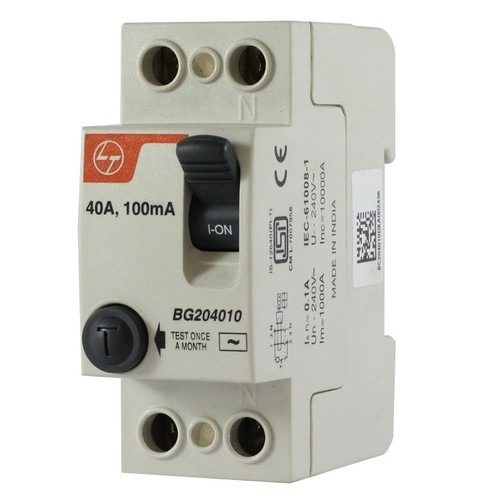
30mA sensitivity — the standard for residential and personal shock protection. At 30 milliamps, the RCCB trips well before the current reaches the threshold that can cause cardiac fibrillation in a healthy adult.
100mA sensitivity — used in commercial and industrial installations where 30mA would cause nuisance tripping under normal operating conditions, but where fire protection against slow insulation breakdown is still needed.
300mA sensitivity — used for fire protection in larger installations, where the goal is to detect significant insulation degradation rather than personal shock protection.
For most Indian homes, a 30mA RCCB is the correct and sufficient choice.
ELCB vs RCCB: Key Differences Explained
Understanding exactly where the two devices differ makes choosing between them straightforward.
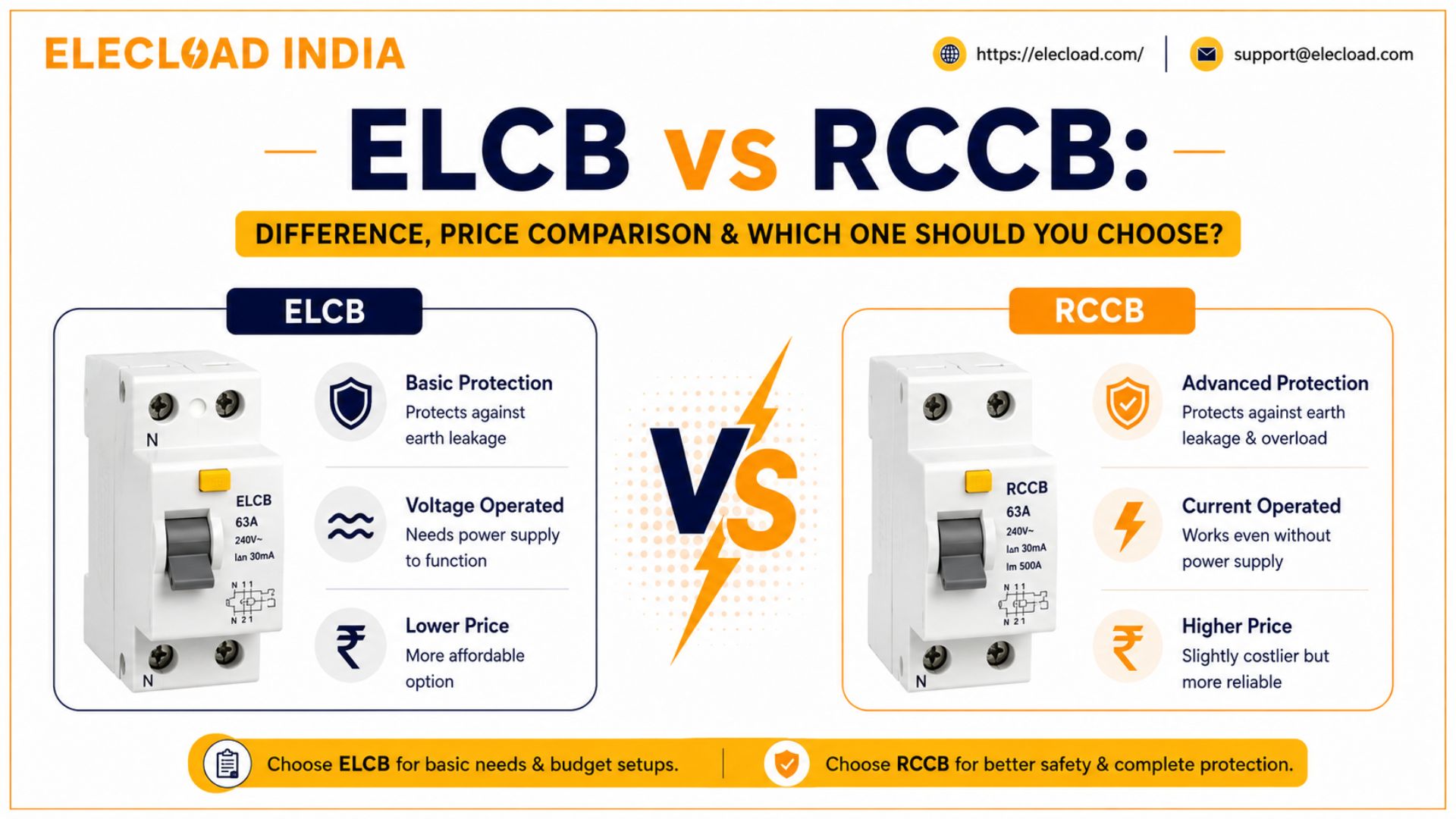
Working Principle. The ELCB operates on voltage sensing. It measures the voltage on the earth conductor and trips when that voltage rises due to a fault. The RCCB operates on current sensing. It measures the difference between live and neutral current and trips when that difference exceeds the rated sensitivity, regardless of where the fault current goes.
Detection Reliability. The ELCB can be defeated by any fault where current finds an alternate earth path. The RCCB detects all leakage regardless of path because it monitors the current balance directly at the device.
Earth Wire Dependency. The ELCB needs to be connected to the earth wire and can only function correctly when that earth wire is in good condition and properly connected. The RCCB does not depend on the earth wire for its protective function, though a proper earth connection is still required for the overall installation.
Modern Standards. The ELCB is considered obsolete for new installations under Indian and international standards. The RCCB is the current standard for earth leakage protection in India.
What They Both Do Not Protect Against. Neither the ELCB nor the RCCB protects against overloads or short circuits. Both devices only deal with earth leakage. For overload and short-circuit protection, MCBs are needed on each outgoing circuit. If you want all three protections in a single device, an RCBO breaker combines RCCB functionality with MCB functionality in one compact unit.
ELCB Price vs RCCB Price in India
This is the question most buyers reach first, and the answer involves more nuance than a simple number comparison.
ELCB Price in India
The eLCB price in India today largely reflects old stock from when the device was more commonly manufactured. Since ELCBs are no longer recommended for new installations and most mainstream Indian brands have shifted their focus to RCCB production, genuine ELCBs from reputable brands are not as readily available as they once were.
Older ELCBs in the market may appear less expensive on the surface, but that lower headline price comes with the significant trade-off of outdated and unreliable protection. When you factor in the real cost of inadequate electrical safety, the apparent savings on the ELCB price make no practical sense for new home wiring or panel upgrades.
RCCB Price in India
The rccb price in India varies across several factors:
Current rating affects the RCCB price significantly. A 25A RCCB for a small residential circuit costs less than a 63A RCCB for a larger incoming supply or commercial application.
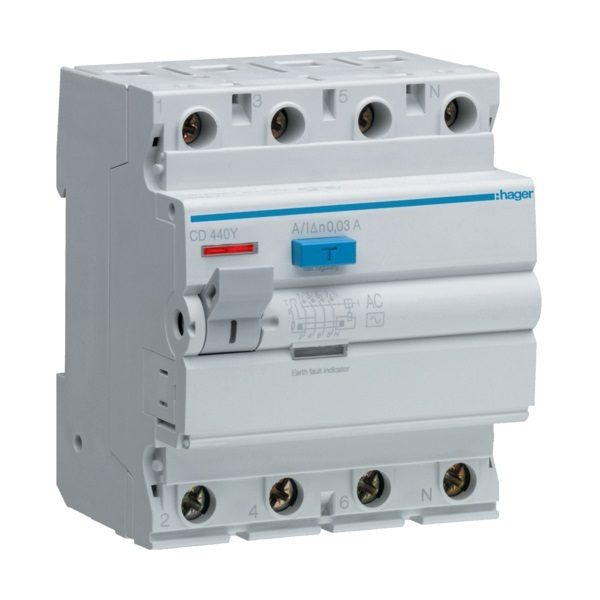
Pole configuration changes the RCCB price considerably. A 2-pole RCCB for single-phase installations is less expensive than a 4-pole RCCB for three-phase supplies.
Sensitivity rating influences cost. A 30mA RCCB for household shock protection sits at a different price point than a 100mA or 300mA variant for industrial fire protection.
Quality and brand name influence the rccb price throughout the marketplace. Premium European brands such as Legrand and Schneider Electric are priced higher than value-oriented Indian brands such as IndoAsian or Goldmedal, which reflect different build quality, as well as testing standards and long-term reliability.
At Elecload India, the complete range of RCCB options from all major brands is available online, allowing buyers to compare specifications and RCCB price across current ratings, pole configurations, and brands before making a decision.
Where Do ELCB and RCCB Fit in a Complete Electrical Installation?
Understanding where these devices sit in the overall wiring system helps clarify why the choice between them matters.
Every electrical circuit in a home or office begins at the distribution board. The main incoming supply enters the board, and individual circuits branch out from there through MCBs to the one way switches, sockets, fans, geysers, and appliances throughout the property.
The RCCB or ELCB sits at the incoming position in the distribution board, either as a standalone device before the individual MCBs or as part of a split load arrangement. Its job is to monitor the entire installation and disconnect when it detects leakage.
For small offices and single-phase homes in India, the SPN distribution board with 30mA RCCB at the incomer is the safest configuration. The RCCB protects against earth leakage for all circuits, and each of the MCBs on each circuit protects against short-circuits and overloads.
For homes that want circuit-by-circuit independent protection, an RCBO breaker on each circuit eliminates the need for a separate RCCB plus MCB combination, since each RCBO handles both earth leakage and overcurrent protection for its own circuit.
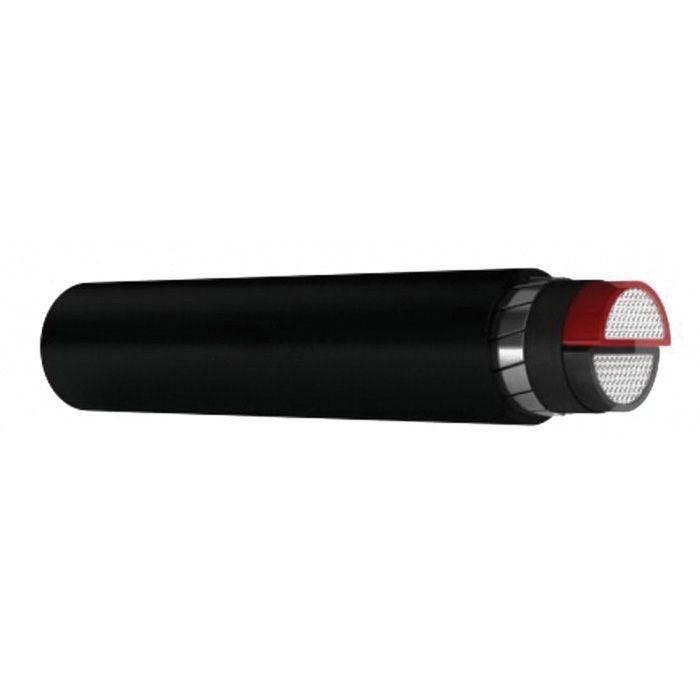
The quality of the cables and wires feeding these protective devices also matters. Using properly rated cables such as those from Finolex, for which you can check the Finolex gold wire price at Elecload India, alongside the correct protective devices, ensures the whole system works as intended. The same applies for heavier loads requiring a 4 core cable for three-phase circuits or checking aluminium cable price for longer distribution runs.
A complete home electrical setup also relies on everyday accessories working alongside these protective devices. An anchor fan regulator manages your ceiling fan speed, and all your light and appliance circuits ultimately terminate at switches and sockets. The RCCB at the incomer protects every one of those end points by monitoring the entire circuit for leakage.
Should You Replace an Old ELCB With an RCCB?
If your home was wired before the year 2000 and still has an old ELCB in the distribution board, upgrading to an RCCB of the same current rating is strongly worth considering.
Old ELCBs can develop mechanical faults silently. The voltage sensing coil can degrade, the contact mechanism can corrode, and the device can appear to be working normally while providing no real protection at all. There is no simple way to verify that an old ELCB will actually trip when needed without testing it under controlled fault conditions.
A modern RCCB from a trusted brand is a reliable, well-tested device built to current Indian electrical standards. Comparing the ELCB price on old stock against the current RCCB price from a brand like Havells, IndoAsian, or Goldmedal, you will find the cost difference is often very small. The safety gain, however, is substantial.
At Elecload India, you can browse through the RCCB range to look up specifications and RCCB prices among brands and place an order online for fast delivery anywhere in India.
Check RCCB Price at Elecload India
Top Brands for RCCB Available at Elecload India
Havells RCCBs are among the most widely used in Indian homes. Reliable tripping response, easy installation, and good after-sales support make Havells the natural first choice for many residential buyers.
Legrand serves the premium residential and commercial segment. Their DX3 series RCCBs are widely specified in high-end housing projects and commercial distribution boards.
Schneider Electric sets the industry benchmark for commercial and infrastructure grade RCCBs. The iID series is found in hospitals, offices, and institutional buildings across India.
Siemens brings German engineering precision to its RCCB lineup, with a strong preference for industrial and infrastructure projects.
IndoAsian and Goldmedal offer cost-effective RCCB options for mid-range residential and commercial projects where quality and budget both need to be balanced.
All these brands are stocked at Elecload India with genuine product assurance, competitive RCCB price, and manufacturer warranty.
Conclusion
The choice between ELCB and RCCB is not really a matter of preference — it is a matter of current standards, reliable protection, and what Indian electrical standards actually recommend.
The ELCB served a useful purpose in an earlier era of Indian electrical installations. Still, its dependence on a single earth path makes it fundamentally unreliable in the conditions found in most Indian buildings today. The RCCB addresses that limitation directly by monitoring the current balance independently of any specific earth path, giving it far superior and more dependable protection.
For any new home wiring or distribution board upgrade, the RCCB is the correct choice. For circuit-by-circuit protection that also handles overloads and short circuits without needing separate MCBs, the RCBO breaker goes one step further. Both are available at Elecload India with genuine brand assurance, competitive RCCB price, and pan-India delivery.
If your home still has an old ELCB, check the current ELCB price and rccb price at Elecload India today. The upgrade is more affordable than most people expect, and the improvement in protection is real.
Browse RCCB and ELCB Range at Elecload India
Frequently Asked Questions
Q1. What is the primary distinction between ELCB and RCCB?
The ELCB works by sensing voltage on the earth wire and only trips when fault current flows through that specific conductor. The RCCB works by measuring the current imbalance between live and neutral and trips regardless of which path the fault current takes. This makes the RCCB far more reliable in real world Indian homes where alternate earth paths are common.
Q2. Is ELCB still recommended for new homes in India in 2026?
No. Indian standard IS 3043 and international IEC standards both recommend against using voltage-operated ELCBs in new installations. The RCCB is the current standard for earth leakage protection. If your home still has an old ELCB, upgrading to an RCCB is strongly advisable.
Q3. What factors affect the RCCB price in India?
The rccb price in India depends on the current rating (25A, 40A, 63A), the pole configuration (2-pole for single phase, 4-pole for three phase), the sensitivity rating (30mA, 100mA, 300mA), and the brand. Premium brands like Legrand and Schneider are priced higher than value brands like IndoAsian and Goldmedal.
Q4. Can I replace my old ELCB with an RCCB?
Yes. An RCCB of the same current rating can be fitted in the same position in most distribution boards. When upgrading, it is also worth checking the overall earthing quality of your installation, since the RCCB monitors current balance rather than earth wire voltage.
Q5. What is an RCBO, and how is it different from an RCCB?
An RCBO breaker combines the earth leakage detection of an RCCB with the overload and short-circuit protection of an MCB in a single compact device. An RCCB only handles earth leakage and needs MCBs alongside it. An RCBO handles all three protections independently per circuit, making it ideal for circuit-by-circuit protection without a shared RCCB covering all circuits together.
Q6. What RCCB sensitivity rating should I use for my home?
For personal shock protection in an Indian residential home, 30mA sensitivity is the correct choice. At 30 milliamps, the RCCB disconnects the circuit before the current can cause fatal harm to a person in contact with a live surface.
Q7. Does an RCCB protect against overloads and short circuits?
No. An RCCB only protects against earth leakage faults. Overload and short-circuit protection require MCBs on each outgoing circuit. For combined protection in a single device, choose an RCBO breaker.
Q8. Which distribution board should I use with an RCCB?
For single-phase homes and small offices, an spn distribution board with a 30mA RCCB at the incomer is the standard setup. The RCCB protects all outgoing circuits while individual MCBs on each circuit handle overcurrent protection.
Q9. Where can I compare the ELCB price and the RCCB price online in India?
You can compare the ELCB price and RCCB price across all current ratings, pole configurations, and brands at Elecload India, elecload.com. Founded in 2019 and operated by Bhavin Joshi from Mumbai, Elecload India offers 100 percent genuine products, manufacturer warranty, secure online payment, and fast delivery across India. Call 9321025013 for product queries.
Q10. Why does my RCCB keep tripping even when there is no obvious fault?
Nuisance tripping of an RCCB is usually caused by ageing cable insulation that has begun to leak small amounts of current to earth, a faulty appliance developing internal leakage, or multiple circuits sharing one RCCB where the combined small leakage from each circuit adds up to trigger the trip threshold. Disconnecting appliances one by one while observing whether the RCCB holds is the practical way to identify the source.
Shop RCCB and ELCB at Elecload India
Published by Elecload India | Founded by Bhavin Joshi | Shop no. 31A, Khajuria Nagar, Khajuria Tank Road, Near Bhadran Nagar, Kandivali West, Mumbai, Maharashtra 400067 | Phone: 9321025013 | Category: Circuit Breakers and Electrical Safety | Last Updated: June 2026

