RCBO Breaker Installation Guide: How to Wire and Connect an RCBO in a Distribution Board
Every time an electrician fits an RCBO breaker into a distribution board, they are installing one of the most capable protection devices available in the Indian electrical market. An RCBO does what no other single device can: it combines overload protection, short circuit protection, and earth leakage protection in a single compact unit that occupies just one or two slots in the panel.
Despite that capability, the installation process is often misunderstood. Some electricians treat an RCBO breaker exactly like a standard MCB, which leads to incorrect wiring of the neutral conductor and a device that provides only partial protection. Others are uncertain which terminal carries live and which carries neutral, or how to verify the Installation is correct before energising the panel.
This guide from Elecload India covers every step of a correct RCBO breaker installation, from understanding the terminal layout to final testing, so that every RCBO fitted gives the full protection it was designed to provide.
At Elecload India, founded by Bhavin Joshi and operating out of Mumbai since 2019, we have a full range of RCBO breaker models manufactured by Hager and LnT, which are available in Double Pole and Four Pole configurations for 6A, 10A, 16A, 20A, 25A, 32A, 40A, and 63A ratings currently. All products are BIS certified, manufactured in India, and come with a full manufacturer warranty.
What Is an RCBO Breaker and How Does It Differ From an MCB and RCCB?
Before getting into the installation steps, it is important to understand exactly what an RCBO breaker does and why it is wired differently from the other protective devices in a distribution board.
An MCB (Miniature Circuit Breaker) is a two terminal device: line in and line out. It monitors the live current through a circuit and trips when that current exceeds the rated amperage due to overload or short circuit. It handles only the live conductor.
An RCCB (Residual Current Circuit Breaker) monitors both live and neutral conductors simultaneously to measure imbalance between them in order to detect earth leakage.
When this exceeds the sensitivity threshold (typically 30mA in Indian homes), the circuit breaker trips instantly; it does not offer protection from overloads or short circuits.
An RCBO breaker does both. Inside a single compact housing, it contains a thermal-magnetic trip mechanism that handles overload and short circuit faults, and a residual current sensing mechanism that handles earth leakage. Because it monitors both live and neutral, it has a dedicated neutral terminal in addition to the standard line terminals. This is what makes its wiring different from a standard MCB, and it is the detail that most installation errors involve.
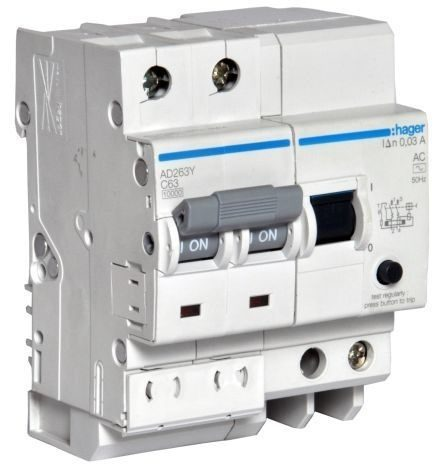
At Elecload India, the Hager RCBO breaker range in Double Pole configuration starts from Rs 2,605, and the LnT range from Rs 3,209, both BIS certified and Made in India.
RCBO Breaker Terminal Layout
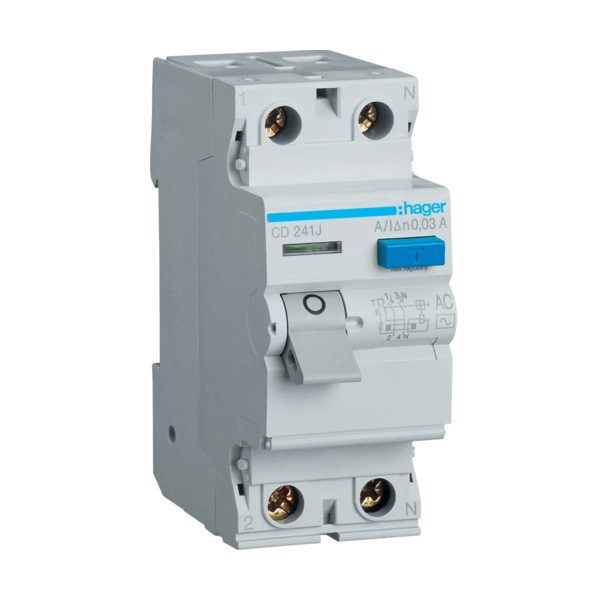
Before picking up a screwdriver, study the terminal markings on the specific RCBO breaker you are installing. Terminal labels vary slightly across manufacturers, but the standard layout for a Double Pole RCBO is as follows.
The top terminals accept the incoming supply. The terminal marked with an arrow pointing downward, or labelled with the number 1 or with L-in, accepts the incoming live conductor. The terminal adjacent to it, often marked N-in or with the number 3, accepts the incoming neutral conductor.
The bottom terminals carry the outgoing load circuit. The terminal marked with an arrow pointing upward, or labelled 2 or L-out, connects to the live conductor going to the circuit being protected. The terminal marked N-out or 4 connects to the neutral conductor going to that circuit.
Some manufacturers also provide an additional earth terminal or an earth flag terminal on the side of the housing. This is not an alternative to the circuit earth; it is the connection point for the device earth, where the RCBO’s internal earth leakage circuitry is referenced. Review the product data sheet of the unit being installed to identify which terminal performs what function.
For Four Pole RCBO breaker units used in three phase installations, there are terminals for all three phase conductors and the neutral, with corresponding outgoing terminals for each. The wiring principle is the same but with three incoming phase conductors instead of one.
Tools and Materials Required for RCBO Installation
Gather the following before starting the Installation:
An appropriate RCBO breaker in the correct current rating and pole configuration for the circuit being protected. Correctly sized single core copper conductors for the live and neutral connections at the distribution board. A flat blade and Phillips screwdriver. Wire strippers and cutters. A non-contact voltage tester to confirm the panel is de-energised before work begins. A digital multimeter for continuity testing after Installation. Approved insulating tape from the PVC insulation tape range for any temporary wire identification or insulation work.
Never work on a live panel. The main incomer switch must be off and confirmed as off using the voltage tester before any connections are made or disturbed.
Step by Step RCBO Breaker Installation Process
Step 1: Isolate the Panel Completely
Switch off the main incomer at the distribution board, using a non-contact voltage tester on both terminals of both the incomer and busbar to confirm all voltage has been removed from your panel; don’t proceed until this test demonstrates zero voltage in all locations where you plan to work.
If the panel feeds back to a meter that cannot be isolated from the incomer side, contact the electricity board to temporarily disconnect the supply before proceeding.
Step 2: Identify the Position for the RCBO Breaker
An RCBO breaker must be installed in a position where its live terminal connects to the phase busbar and its neutral terminal connects to the neutral busbar. In a standard split load or full load distribution board, this means the RCBO occupies the same type of slot as an MCB for its live connection, with the neutral conductor routed separately to the neutral bar.
Mark the location clearly before unplugging anything from the panel, so that conductor routing can be planned prior to starting to wire.
Step 3: Remove the Blanking Plate and Fit the RCBO Breaker
If the selected position is currently blank, remove the blanking plate by releasing its clip. Snap the RCBO breaker onto the DIN rail at that position firmly until the clip audibly engages. The unit should sit level and flush with the adjacent devices. If the RCBO is replacing an existing MCB, remove the old MCB after disconnecting all conductors from it first.
Step 4: Connect the Incoming Live Conductor
Remove approximately 8-10mm of insulation from the end of an incoming live conductor and insert it into the L-in terminal (top live terminal) of an RCBO breaker, tightening its terminal screw according to torque specifications provided on product data sheets. Be careful not to over-tighten as overdoing it could damage terminal clamps and create high resistance connections – give the conductor a firm pull afterwards to make sure everything is secure.
For the busbar connection, the RCBO’s line-in terminal connects to the phase busbar in the same way as any MCB in the panel. Follow the existing busbar connection method used for other devices in the panel.
Step 5: Connect the Incoming Neutral Conductor
This is the step that most differentiates an RCBO breaker installation from an MCB installation. Strip 8 to 10mm from the incoming neutral conductor. Connect it to the N-in terminal (top neutral terminal) of the RCBO. This conductor comes from the neutral busbar or neutral bar of the distribution board.
Confirm the neutral is correctly routed. A neutral that bypasses the RCBO and connects directly to the neutral bar at the load side of the device will defeat the earth leakage protection completely, because the RCBO will not be measuring the neutral return current for that circuit.
Step 6: Connect the Outgoing Live and Neutral to the Load Circuit
The conductors going from the RCBO to the circuit being protected connect to the bottom terminals. The outgoing live conductor connects to L-out. The outgoing neutral conductor connects to N-out. These are the conductors that run from the distribution board through the electrical conduits in the wall to the circuit’s sockets, switches, or appliances.
If the circuit wiring runs through PVC conduits concealed in the walls, confirm that the conduit run is correctly routed and that junction boxes at branch points are properly installed before energising the circuit.
Step 7: Connect the Earth Conductor
Earth conductors from load circuits should connect directly to the main earth bar of a distribution board rather than to an RCBO directly, so as not to interrupt continuity regardless of whether an RCBO trips. This is an essential wiring requirement that must always be respected.
Step 8: Verify All Connections Before Closing the Panel
Once all conductors are connected and the panel remains de-energised, visually inspect every terminal to make sure no conductor has been crossed-connected, the neutral has not gone around the RCBO, and no exposed conductor beyond the terminal clamp has bare wire exposed beyond the terminal clamp. Finally, ensure the earth conductor routes directly to the earth bar rather than any protective devices.
Use the continuity feature on a multimeter to check that both live circuits from an RCBO output to load sockets or switches are complete, as well as that the neutral return path through its neutral terminal is complete.
Step 9: Test the RCBO Breaker Before Energising the Circuit
Switch on the main incomer and energise the panel, followed by switching on the newly installed RCBO breaker. Pressing the test button on the front face of the RCBO should simulate a small earth leakage current, which should cause it to trip immediately if pressed; if not, you must investigate before adding loads to it.
A correctly installed RCBO breaker will always trip within the specified disconnection time (typically under 40 milliseconds) when the test button is pressed.
Step 10: Connect the Load and Final Verification
Reconnect the load circuit. Under normal operating conditions, use all switches and sockets it serves to test its functionality. If your circuit includes one-way switches for lighting or sockets for appliances, ensure each outlet works as intended. If an RCBO trips without any discernible fault being present in the circuit, investigate further, as earth leakage could still exist before concluding that Installation is complete.
Common Wiring Mistakes to Avoid When Installing an RCBO Breaker
Bypassing the neutral through the RCBO
The most common error. The neutral conductor for the protected circuit must pass through the RCBO’s neutral terminals, not connect directly to the neutral bar. Bypassing the neutral means the RCBO cannot measure the live-neutral imbalance and provides no earth leakage protection.
Connecting the neutral in the wrong direction
The incoming neutral from the neutral bar must connect to N-in. The outgoing neutral to the load must connect to N-out. Reversing these defeats the protection mechanism.
Sharing a neutral between an RCBO circuit and another circuit
If the neutral from the RCBO protected circuit is shared with a circuit that does not pass through the same RCBO, the neutral current measured by the RCBO will always show an imbalance, causing nuisance tripping.
Using undersized conductors for the RCBO rating
If an RCBO is rated to carry 32A, conductors used must be capable of safely supporting this load. Undersized wire may not trigger its thermal trip until after overheating has taken place and led to significant overheating along its path.
Do not test the device after Installation
Every newly installed RCBO breaker must be tested with the built-in test button before the circuit is handed over or used.
RCBO Breaker vs RCCB Plus MCB: Which Setup Should You Choose?
Many Indian distribution boards use a single RCCB at the receiver to provide earth leakage protection, with individual MCBs for overload and short circuit protection further downstream. Although this arrangement may seem convenient, any fault occurring on any circuit could trigger it all at once and trip off all RCCBs simultaneously.
Individual RCBO breakers on each circuit eliminate this problem. A fault on one circuit trips only that circuit’s RCBO. All other circuits remain live. This is why RCBO breakers are increasingly specified in premium residential projects, commercial offices, and any installation where continuous operation of unaffected circuits matters when one circuit develops a fault.
Cost can be the deciding factor; an RCBO costs more per circuit than its standard MCB counterpart, and specifying multiple individual RCBOs rather than using an RCCB with multiple MCBs leads to increased panel costs; however, its operational advantages make the investment worthwhile.
For the complete RCBO breaker range from Hager and LnT at Elecload India, browse online and compare specifications before specifying.
Wiring the Distribution Board Environment: What Else Needs Attention
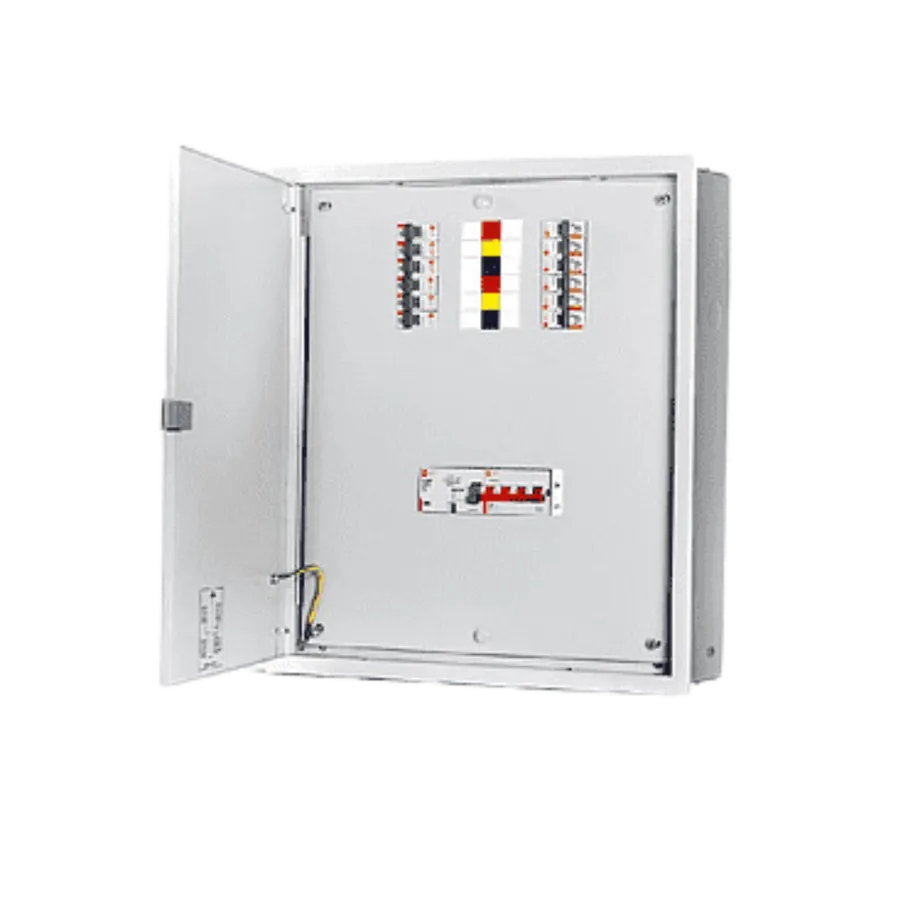
An RCBO breaker installation does not happen in isolation. The wider distribution board and wiring environment needs to be correctly set up for the RCBO to function as designed.
The distribution board housing the RCBO must be correctly earthed. The earth bar must have a solid connection to the main earth electrode. Without a functioning earth, the RCBO’s earth leakage detection is ineffective even if the device itself is correctly wired.
All circuit wiring must run through properly installed electrical pipes or conduits where the installation specification requires concealed wiring. Every branch point in the conduit run must have a proper junction box. Joints made inside conduit pipes rather than inside junction boxes cannot be inspected or maintained. This is both a code requirement under IS 732 and a practical installation standard.
Cable saddles at regular intervals along the conduit run ensure the conduit does not sag before plastering and that the cable routing is properly supported throughout its run.
At Elecload India, the complete range of PVC conduits, junction boxes, cable saddles, and insulation tape from Precision Pipes is available alongside the RCBO breaker range, allowing the complete panel and wiring system to be sourced from a single platform.
Conclusion
Installing an RCBO breaker correctly is one of the easiest and most effective steps electricians and electrical contractors can take to increase circuit safety. Installation should be straightforward when the terminal layout is understood, the neutral is routed through rather than bypassed, and the test button is used to validate that the earth leakage mechanism has worked post-installation.
At Elecload India, the complete range of RCBO breakers from Hager and LnT covers every common current rating and pole configuration, all BIS certified and Made in India, available online with manufacturer warranty and fast delivery across India.
Frequently Asked Questions
Q1. What is an RCBO breaker and what does it protect against?
An RCBO combines features of both an MCB and RCCB into one device for comprehensive circuit protection against overloads, short circuits, earth leakage, and earth fault – making it the most comprehensive single circuit protection device on Indian electrical markets.
Q2. How is an RCBO breaker wired differently from a standard MCB?
An MCB has only two terminals: live in and live out. An RCBO breaker has four terminals: live in, neutral in, live out, and neutral out. The neutral conductor for the protected circuit must pass through both the N-in and N-out terminals of the RCBO. This is how the device measures the imbalance between live and neutral current to detect earth leakage.
Q3. Can I replace an existing MCB with an RCBO breaker?
Yes, but the neutral conductor wiring must be modified. When replacing an MCB with an RCBO breaker, the neutral for that circuit must be rerouted from the neutral bar through the RCBO’s N-in and N-out terminals rather than connecting directly to the neutral bar as it would in a standard MCB circuit.
Q4. What current ratings are available for RCBO breakers at Elecload India?
At Elecload India, Hager and LnT RCBO breaker units are available in 6A, 10A, 16A, 20A, 25A, 32A, 40A and 63A ratings in Double Pole configuration, and selected ratings in Four Pole configuration for three phase applications. All units are BIS certified and made in India.
Q5. Why does my RCBO breaker trip when I press the test button?
Tripping when the test button is pressed is the correct behaviour. The test button simulates a small earth leakage current. The RCBO detects this as a fault and trips the circuit. This confirms the earth leakage detection mechanism is working correctly. If the RCBO does not trip when the test button is pressed, the Installation has an error and must be investigated.
Q6. Can one RCBO breaker protect multiple circuits?
No. Each RCBO breaker is designed to protect a single circuit. Its neutral terminal carries only the neutral return for the circuit it protects. Running multiple circuit neutrals through a single RCBO would create permanent neutral current imbalance and cause continuous nuisance tripping.
Q7. What is the difference between a Double Pole and Four Pole RCBO breaker?
A Double Pole RCBO breaker has one line terminal and one neutral terminal, suitable for single phase circuits. A Four Pole unit has three line terminals and one neutral terminal, suitable for three phase circuits in commercial and industrial applications. Choose based on whether your circuit uses single phase or three phase supply.
Q8. Should I use individual RCBO breakers or one RCCB with multiple MCBs?
Individual RCBO breakers for each circuit ensure that a fault in one circuit only affects it, leaving all others operational. By contrast, RCCBs cover multiple circuits simultaneously; therefore, any disruption anywhere hits all circuits at the same time. Individual RCBOs cost more per circuit but offer superior circuit independence – the appropriate choice depends on your project budget and the importance of maintaining continuity when one of them experiences a fault.
Q9. What tools do I need to install an RCBO breaker correctly?
Before beginning work on any panel, you will require the appropriate screwdriver and wire strippers, a non-contact voltage tester, and a digital multimeter. Never work on an electrical panel that remains live!
Q10. Where can I buy genuine RCBO breakers online in India?
You can buy genuine Hager and L&T RCBO breaker units in Double Pole and Four Pole configurations at Elecload India, elecload.com. Founded by Bhavin Joshi in December 2019 and based in Mumbai, Elecload India offers BIS certified, Made in India products with manufacturer warranty, secure online payment, and fast delivery across India. Call 9321025013 for product queries and bulk pricing.