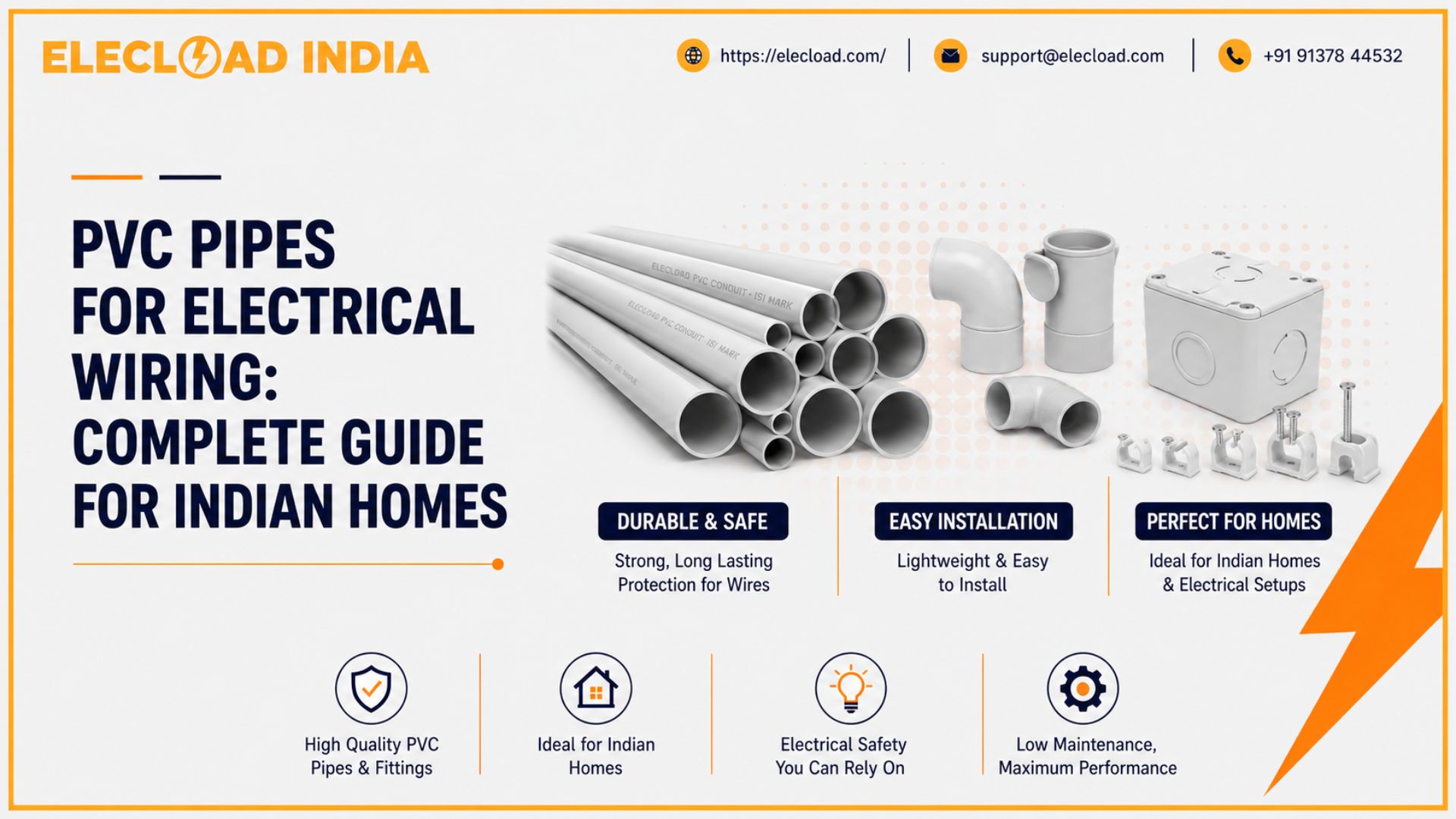
PVC Pipes for Electrical Wiring: Complete Guide for Indian Homes
Walk into any Indian home built in the last two decades, and the wiring is almost certainly hidden inside the walls. What most people never think about is the thin plastic tube running behind that plaster, quietly protecting every wire from moisture, physical damage and heat. That tube is the PVC pipes and PVC conduits system, and getting it right is one decision that is nearly impossible to correct once the plaster has gone up.
This guide from Elecload walks through what these conduits actually are, the sizes and grades used across Indian homes, how a typical installation is carried out, and what else you should keep on your shopping list when you order conduit pipes for a new build or renovation.
What Are PVC Conduits and Why Do They Matter
A conduit is simply a protective tube that wiring is pulled through before it is concealed inside a wall, ceiling or floor slab. Without this tube, a cable resting directly inside wet plaster would be exposed to moisture, and any future rewiring would mean breaking open the wall completely.
PVC conduits made from unplasticised polyvinyl chloride, commonly called uPVC, are the standard choice for residential and light commercial wiring in India because they are lightweight, corrosion resistant, non conductive and easy to cut and join on site. Rigid PVC conduits used for electrical work are manufactured to the IS 9537 Part 3 standard, while the fittings that connect them, such as bends, tees and couplers, follow the IS 3419 standard. Genuine conduit pipes from reputed brands carry the ISI mark, confirming that the material has passed BIS testing for impact strength, dimensional accuracy and fire resistance.
LMS, MMS and HMS: Understanding Conduit Grades
One detail that surprises many first time buyers is that not all PVC pipes are built for the same job. The IS 9537 Part 3 standard classifies rigid conduits into three mechanical strength grades.
- LMS (Light Mechanical Strength): Suitable for false ceilings and light duty concealed work where the pipe is not under heavy structural load
- MMS (Medium Mechanical Strength): The most commonly used grade for standard residential wiring inside walls and slabs
- HMS (High Mechanical Strength): Built for heavy duty surface wiring, underground runs, and installations where the conduit may face impact or pressure
Choosing the wrong grade for the location is one of the most common mistakes on residential sites, since an LMS pipe used under a concrete slab can crack under the weight of the pour. In contrast, an HMS pipe used behind a false ceiling is simply an unnecessary expense.
PVC Pipe Size Guide for Indian Homes
Conduit size is measured by outer diameter in millimetres, and the right size depends on how many wires need to pass through the pipe together. 20mm PVC pipes are the most widely used size in residential wiring for single circuits such as a light point or a switchboard feed, while larger diameters handle bunches of cables or higher current runs.
| Conduit Size | Common Use |
|---|---|
| 20mm | Single circuit wiring, light points, switch boards |
| 25mm | Multiple wire runs, small distribution feeds |
| 32mm | Heavier bunches of cable, sub main runs |
| 50mm | Main incoming feeds, commercial and industrial runs |
Elecload currently stocks precision PVC pipes across the 20mm, 25mm and 32mm range in all three grades. Below is a snapshot of the current price for the entry length of each combination.
| Size | Grade | Price Starting From |
|---|---|---|
| 20mm | LMS | ₹46.61 |
| 20mm | MMS | ₹51.98 |
| 20mm | HMS | ₹71.36 |
| 25mm | LMS | ₹64.35 |
| 25mm | MMS | ₹73.43 |
| 25mm | HMS | ₹90.75 |
| 32mm | LMS | ₹89.51 |
| 32mm | MMS | ₹73.43 |
| 32mm | HMS | ₹142.73 |
Since these are variant based listings with multiple length options, prices scale up depending on the bundle or coil length you select. We recommend checking the live listing before placing a bulk order, since site wide pricing is updated periodically.
How PVC Conduit Pipes Are Installed
Concealed conduit wiring often follows a set process on site, and understanding its basic steps helps you communicate more efficiently with an electrician or contractor.
Marking the route: The electrician marks the wiring path on the wall or slab, working from the distribution board outward to each switchboard and light point.
Chasing the wall or laying in the slab: For wall wiring, a groove is cut into the brickwork to house the pipe. For slab wiring, the conduit is laid before the concrete is poured, which is why HMS grade pipes are typically used here to withstand the weight and pressure of the pour.
Fixing the conduit: The pipe is fixed in place using clips or by embedding it directly, with couplers and bends used at every joint or turn to maintain a continuous, snag free path for the wire.
Boxing at switch points: A concealed box or a PVC junction box is fitted at every switch, socket or joint location, giving the wire a safe termination point and making future maintenance far easier.
Pulling the wire: Once all conduit networks and wall or slab work are finished, electrical wire must be pulled through using fish tape or draw wire in preparation for final connection at the distribution board.
Sealing and finishing: Open ends are capped, and the wall is finished with plaster or the slab is cured, leaving only the switchboards and points visible.
PVC Conduits vs Other Wiring Protection Options
While PVC pipes dominate residential concealed wiring in India, a couple of alternatives are worth knowing about.
Flexible PVC conduits: These are corrugated and bendable, often used where the wiring path has many curves or where quick, tool free installation is needed, though they generally offer less mechanical protection than rigid uPVC pipe.
Steel conduits: Used mostly in industrial or high security installations where fire resistance and mechanical strength requirements exceed what PVC can offer, though they cost considerably more and require threading tools for installation.
For the vast majority of homes and small commercial spaces in India, rigid uPVC conduit strikes the right balance of cost, durability and ease of installation, which is why it remains the default choice recommended by electricians across the country.
Buying Tips Before You Order PVC Pipes
- Match conduit grade to your installation location; MMS should be used for standard wall wiring while HMS should be chosen for slab or underground work.
- When selecting pipe diameter, be guided by both the number and gauge of wires you need to pass through simultaneously rather than habit or guesswork.
- Always check for the ISI mark and BIS licence details on the pipe body before accepting delivery.
- Buy a small percentage extra length to account for wastage during cutting and fitting.
- Pair every conduit run with matching bends, couplers and a properly rated PVC junction box at each termination point.
- If you are comparing brands, note that pricing across brands such as Precision and other market names like Polycab PVC pipe prices can vary based on grade, length and current material rates, so always compare like for like specifications.
What Else You Need Alongside Conduit Pipes
A complete concealed wiring job is rarely just about the pipe. Most electricians also budget for the following accessories from the same PVC pipe and cable accessories range.
Junction and adaptable boxes: Every branch point, switch location or joint needs a properly sized PVC junction box to keep the connection safe and accessible for future work.
Cable fixing accessories: For any surface run that is not concealed inside conduit, saddles are used to clip the cable neatly along the wall or ceiling.
Insulation accessories: PVC tape is a standard item on every electrician’s toolkit for insulating joints and terminations.
Switches and finishing accessories: Once the wiring is pulled through and terminated, the visible part of the installation is finished with modular switches at each point.
Where to Buy PVC Pipes Online in India
Elecload India has been offering genuine electrical products since 2019, including our PVC pipe range of Precision brand uPVC conduit pipes in LMS, MMS and HMS grades of 20mm, 25mm and 32mm sizes backed by transparent wholesale friendly pricing with bulk discounts available for contractors and builders. If you are looking to buy PVC pipes online, check current stock, compare sizes/grades, and place your order for quick delivery across India.
Frequently Asked Questions
1. What are the differences between PVC pipe and conduit?
In everyday use, the terms are often used interchangeably for electrical wiring applications. Technically, a conduit refers specifically to the protective tubing used to house electrical cables, manufactured to IS 9537 Part 3. At the same time, PVC pipe can also refer to plumbing pipe made to a different standard, so it is always worth confirming that you are buying an electrical grade conduit pipe.
2. Which size PVC pipe is used for home wiring in India?
20 mm PVC pipes are the most commonly used size for single circuit wiring such as light points and switchboards in Indian homes. Larger sizes such as 25mm and 32mm are used where multiple wires need to run together or where the load is higher.
3. What do LMS, MMS and HMS mean on a conduit pipe?
These are the three mechanical strength grades defined for rigid PVC conduits. LMS is light duty and suited to false ceiling work, MMS is medium duty and used for standard wall wiring, and HMS is heavy duty and used for slab or underground installations.
4. Are Precision PVC pipes ISI marked?
Yes, the Precision uPVC conduit pipes available on Elecload are ISI marked and manufactured in India, meeting the applicable BIS requirements for electrical conduit pipes.
5. Can I install PVC conduit pipes myself?
Basic surface conduit work may be performed safely by anyone; however, concealed wiring within walls or slabs must always be handled by a licensed electrician as incorrect routing and grade selection can compromise both safety and ease of future maintenance.
6. What accessories do I need along with PVC conduit pipes?
A complete concealed wiring setup usually needs bends, couplers and tees to route the conduit around corners, along with a PVC junction box at every switch, socket or branch point, plus PVC tape for insulating joints.
7. How is Polycab PVC pipe price different from Precision PVC pipe price?
Pricing between brands generally reflects differences in manufacturing scale, distribution and marketing rather than a major difference in core specification, since both are expected to meet the same IS 9537 Part 3 standard when genuinely certified. Elecload currently stocks the Precision range, and pricing for that range is available on our PVC pipe category page.
8. Do PVC conduit pipes catch fire easily?
Genuine ISI marked PVC conduit pipes undergo testing for fire propagation resistance as part of IS 9537 Part 3 certification, meaning that they should resist sustaining flame under standard test conditions but may still ignite under extreme heat conditions.
9. What is the standard length of a PVC conduit pipe coil or bundle?
Length options vary by product and are shown as selectable variants on each listing, since pipes are commonly sold in standard bundle lengths for retail purchase and in larger coil lengths for bulk or contractor orders.
10. Where can I buy genuine PVC pipes online in India?
Elecload India provides genuine ISI marked PVC conduit pipes at transparent pricing with bulk discounts for contractors and lightning fast delivery across major Indian cities. Shop our Precision range today!