Conduit Junction Box: What It Is & Where to Use It?
Every correctly wired home in India has dozens of joints hidden inside its walls, ceilings, and floors. Each of those joints connects two or more electrical conductors and allows circuits to branch from main runs to individual switch and socket points. And every one of those joints should be housed inside a conduit junction box.
Most homeowners never see these boxes after the plastering is done. Most electricians place them during the rough wiring stage and think about them very little after that. But getting junction box selection and placement right is one of the details that separates a compliant, maintainable wiring installation from one that causes problems years down the line.
This guide from Elecload India explains what a conduit junction box is, why it is a mandatory requirement under Indian electrical standards, the different types available in the Precision Pipes range, where each type is used in practice, and how to select the right configuration for each position in a home or commercial wiring layout.
What Is a Conduit Junction Box?
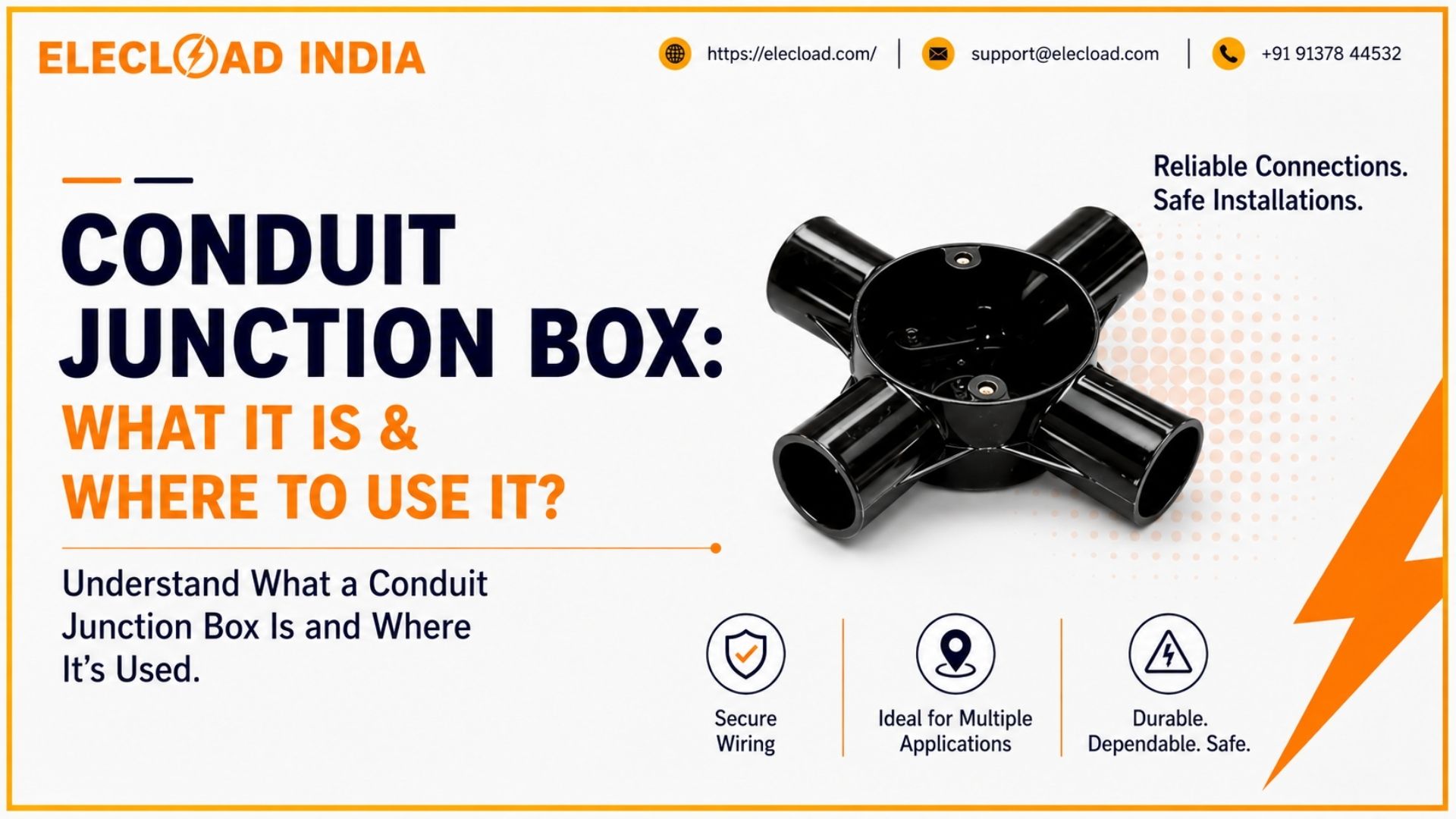
A conduit junction box is a hollow enclosure made from flame-retardant PVC that is installed wherever two or more electrical conduit pipes meet and where wire connections need to be made inside a protected, accessible housing.A conduit junction box is a hollow enclosure made from flame-retardant PVC that is installed wherever two or more electrical conduit pipes meet and where wire connections need to be made inside a protected, accessible housing.
The name comes directly from its function. It sits at the junction point of a conduit wiring system and provides a box shaped enclosure for the wire joints at that point. Without it, the only alternative would be to make the joint inside the conduit pipe itself, which is both a code violation under IS 732 and a practical problem because any joint made inside a pipe and then plastered over becomes inaccessible for inspection or repair.
A conduit junction box solves both problems. It provides a proper enclosure for the joint; it allows the conduit to connect in from multiple directions through knockout entry points around its perimeter; and it stays permanently accessible through a flush-fitted cover plate even after the surrounding wall or ceiling is plastered.
Elecload India offers 27 products from their Precision Pipes conduit junction box range that cover circular, deep circular and fan box styles with conduit entry sizes of 19mm, 20mm, 25mm, and 32mm that meet IS 3419 specifications.
Why IS 732 Makes Junction Boxes Mandatory
IS 732 is the Indian standard that governs electrical wiring in buildings. Under its requirements, every wire joint in an electrical installation must be housed in an accessible enclosure. This is not a recommendation. It is a requirement that applies to every residential and commercial wiring project in India.
Practical reasons are easy to grasp: wire joints can malfunction, conductors can become detached from terminals, and insulation can degrade over time. An accessible conduit junction box with a cover plate enables inspection at regular intervals as well as testing when faults appear on a circuit, so that electricians can carry out repairs without breaking through walls.
A joint made directly inside a conduit pipe and buried under plaster offers none of those options. If it fails, the only remedy is destructive wall investigation to find and access the joint, which is both disruptive and expensive.
Every PVC junction box in a correctly installed wiring system should be:
Positioned so that its cover plate is flush with and accessible through the finished wall or ceiling surface. Fixed firmly to the structural element behind it before plastering, so it cannot shift. Sized correctly so that the conduit entries match the conduit pipe diameter being used. Large enough internally to accommodate all the conductors meeting at that point without crowding.
Types of Conduit Junction Box Available at Elecload India
All conduit junction box products at Elecload India come from Precision Pipes, one of India’s most trusted names for uPVC electrical conduit fittings. The range covers the four configurations needed for standard residential and commercial wiring layouts.
1-Way Terminal Box
A 1-way terminal conduit junction box has a single conduit entry point. It is used at circuit termination points, which are positions where a conduit run ends rather than branches. Typical positions for 1-way boxes include light fitting positions where the circuit wire terminates at the ceiling fitting, and some switch positions where the conduit enters from only one direction.
At Elecload India, the Precision 20mm 1-way terminal box is priced from Rs 12.79 per unit, making it the most affordable option in the circular box range. The 25mm version starts from Rs 15.95 and the 32mm version from Rs 29.56 per unit.
2-Way Angle Box
A 2-way angle conduit junction box has two conduit entry points arranged at 90 degrees to each other. It is used wherever the conduit route changes direction at a corner, handling the turn in the run while providing a joint housing at the same position.
In typical room wiring, conduit runs often turn corners where walls meet ceilings or where surface runs change direction. At each of those corners, a 2-way angle box handles both the directional change in the conduit route and the housing of any wire joints at that point.
2-Way Through Box
A 2-way through conduit junction box has two conduit entry points arranged directly opposite each other. It is used on straight conduit runs where the circuit passes through a junction point but continues in the same direction, providing a mid-run access point or joint housing without changing the direction of travel.
3-Way Tee Box
A 3-way tee conduit junction box has three conduit entry points, typically one entry and two exits or one entry from a main run and two branches leaving from the box. This is one of the most commonly used types in residential wiring, since most circuits branch at some point. A lighting circuit that runs from the distribution board along a corridor and then branches to feed individual room lights will need 3-way tee boxes at each branch point.
4-Way Intersection Box
Four-way intersection conduit junction boxes feature four conduit entry points on either side of their circular housing. They’re ideal for use when multiple conduit runs converge at complex branch points where circuits need to branch off simultaneously in both directions – something often found in commercial wiring environments or larger homes with multiple conduit runs running into ceiling spaces or technical areas.
Deep Circular Box
The deep version of the circular conduit junction box has the same footprint and the same conduit entry configurations (1-way, 2-way, 3-way, 4-way) as the standard circular box, but with significantly greater internal depth, typically around 60mm or more compared to the standard depth.
Deep boxes are used at positions where more conductors need to be connected than a standard depth box can comfortably accommodate, where cable bundles are bulkier because of larger wire gauge, and where multiple circuits converge at a single point. At Elecload India, the Precision 20mm 4-way deep circular box is priced at Rs 25.44 per unit and the 25mm version at Rs 32.86.
Standard Sizes and Which Conduit They Match
The conduit entry size of a conduit junction box must match the diameter of the PVC conduit pipe being used in the installation. Using a box with a 20mm entry on a 25mm conduit run leaves a gap at the entry point that allows plaster to enter the box during construction.
Elecload India offers four standard sizes of its Precision conduit junction box range; 19mm being the smallest size used for older installations or light circuit wiring; while 20mm being most commonly seen in Indian residential wiring (it matches standard conduit sizes used for lighting, socket and general circuit wiring); 25mm size being for heavier circuits that require larger conduit sizes such as dedicated air conditioning/geyser circuits and 32mm being used in sub-main conduit runs and commercial wiring where larger cable routes between distribution points.
When planning a wiring project, confirm the conduit size being used for each circuit route and select conduit junction boxes of the matching entry size throughout.
Where to Use a Conduit Junction Box in Home Wiring
Understanding the correct placement positions for a conduit junction box is as important as selecting the right type. These are the positions in a standard Indian home where a box must be fitted.
At every point where the conduit route branches from a main run to a sub-circuit or appliance feed. This is the most common junction box position and requires a 3-way or 4-way box depending on how many branches leave from that point.
At every point where the conduit route changes direction by 90 degrees or more. A 2-way angle box handles these corners while providing the required joint housing at the change of direction.
At every circuit termination point. Wherever a conduit run ends, at a light fitting position, at the back of a ceiling fan box, or at a surface mounting position, a 1-way terminal box provides the enclosed termination point.
At every mid-run access point on a long straight conduit run. IS 732 requires accessible inspection points at regular intervals along conduit runs, and a 2-way through box on a straight run provides this access without interrupting the conduit direction..
In practice, every room in a standard Indian 2BHK home will have between 8 and 15 conduit junction box positions in its wiring layout, covering lighting circuit branches, socket circuit branches, fan circuit terminations, and switch drop points.
The Complete Wiring System: How Junction Boxes Connect to Everything Else
A conduit junction box is one component in a complete electrical installation, and choosing the right boxes for each position is only meaningful when the rest of the system is correctly specified too.
The wires that pass through these boxes and the conduits connecting them need to be correctly sized for their circuit. ISI marked house wire from trusted brands is the foundation. Checking the current Finolex Gold wire price at Elecload India gives you a reference point for one of the most trusted FR 90 house wire brands available in India.
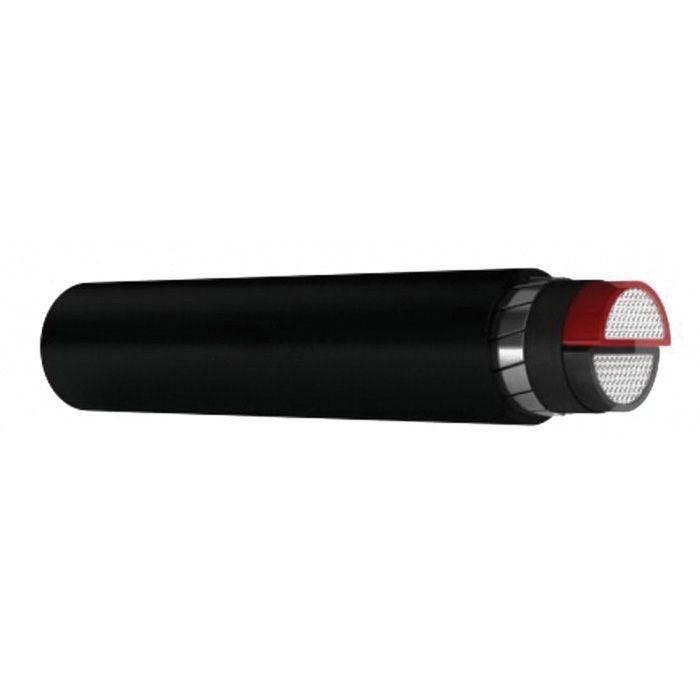
For outdoor and underground supply runs bringing power into the building, checking the aluminium cable price at Elecload India covers the main incoming cable requirements before the wiring reaches the distribution board and the conduit system inside the building.
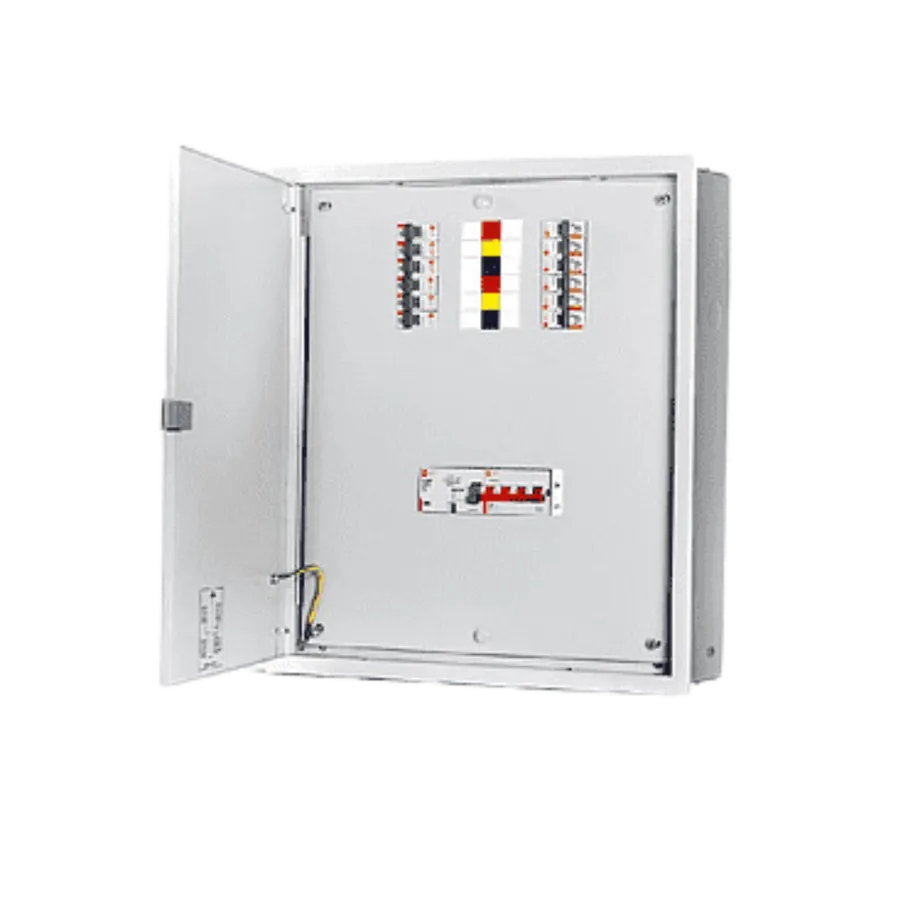
At the distribution board, the circuit protection devices, including RCCB and MCB combinations, protect all the circuits that the conduit junction boxes serve. Comparing the current RCCB price across available brands at Elecload India before finalising the panel design ensures the protection budget is accurately planned alongside the conduit and junction box budget.
At the end of each circuit protected by those devices, the visible fittings the homeowner actually uses every day include one way switches for lighting and socket control, and a fan speed control device such as an anchor fan regulator at each ceiling fan position. The conduit junction box at each of those positions is the connection housing that makes the circuit to each fitting safe and accessible.
Between the distribution board and the switch and socket positions, the conduit pipes themselves need to be supported at regular intervals using cable saddles before plastering, and every wire joint exposed during installation needs to be wrapped correctly using ISI marked pvc insulation tape.
Choosing the Right Conduit Junction Box at Elecload India
With 27 PVC junction box and conduit junction box products in the Precision Pipes range at Elecload India, selecting the right products for a project is straightforward once the conduit layout is planned.
For each branch point in the conduit layout, count the number of conduit pipes meeting at that point to determine whether a 2-way, 3-way, or 4-way box is needed. For each circuit termination point, a 1-way terminal box is correct. For positions where a higher number of conductors will be joined, specify a deep circular box rather than a standard depth box. Match the entry size of every box to the conduit diameter being used on that section of the run.
Elecload India provides IS 3419-compliant Precision Pipes conduit junction box products at competitive prices, made in India for fast delivery online, starting with 1-way terminal boxes at Rs 12.79 each up to 32mm 4-way deep circular boxes for 32mm diameter applications – making quality conduit fittings accessible for projects of every scale.
Shop the complete conduit junction box and PVC junction box range at Elecload India today.
Conclusion
A conduit junction box is not something to take lightly; in accordance with IS 732, it must be present at every wire joint position in any properly installed Indian electrical wiring system. Selecting the ideal type for each location – such as 1-way terminals, 2-way angles, 3-way tees and 4-way intersections or deep circular boxes where more space is necessary – ensures that every joint in your installation remains accessible during its entire lifespan and remains safe and accessible over its lifecycle.
The Precision Pipes range of conduit junction boxes and PVC junction box products at Elecload India covers all standard configurations across 19mm, 20mm, 25mm, and 32mm entry sizes, all IS 3419 compliant, Made in India, and available online at competitive prices with fast delivery across India.
Frequently Asked Questions
Q1. What is a conduit junction box and what is it used for?
A conduit junction box is a PVC enclosure designed to protect and house wire joints in conduit wiring systems where connections are made or where conduit pipes branch off, as well as make the joint easily accessible for inspection and repair purposes; they are required under IS 732 for all electrical wiring installations in India.
Q2. Why must wire joints be made inside a conduit junction box rather than inside the conduit pipe?
A joint made directly inside a conduit pipe is inaccessible once the surrounding wall or ceiling is plastered. IS 732 requires all wire connections to be housed in enclosures that remain accessible throughout the life of the installation. A conduit junction box with a flush-fitted cover plate keeps every joint permanently reachable for testing and repair.
Q3. What is the difference between a 2-way angle box and a 2-way through box?
A 2-way angle conduit junction box has its two conduit entries arranged at 90 degrees to each other and is used at direction changes where the conduit turns a corner. A 2-way through box has its two entries directly opposite each other and is used on straight conduit runs where an access point or joint housing is needed without changing direction.
Q4. When should I use a deep circular box instead of a standard circular conduit junction box?
Deep circular boxes may be required in situations with multiple conductors colliding more densely than can be accommodated within a standard depth box, where heavier gauge wire creates bulkier terminations, or where multiple circuit branches converge at one location requiring greater internal volume for connection purposes.
Q5. What conduit entry sizes are available in the Precision Pipes junction box range at Elecload India?
The Precision Pipes conduit junction box range at Elecload India is available in 19mm, 20mm, 25mm, and 32mm conduit entry sizes. The 20mm size is the most commonly used in standard Indian residential wiring, while 25mm suits heavier circuits and 32mm is used for sub-main and commercial conduit runs.
Q6. How much does a conduit junction box cost at Elecload India?
Precision Pipes conduit junction box products at Elecload India start from Rs 12.79 per unit for the 20mm 1-way terminal circular box and range up to Rs 35.61 per unit for the 32mm 4-way deep circular box. All prices include the standard ISI marked Precision Pipes quality and IS 3419 compliance.
Q7. Can a conduit junction box be used outdoors or in wet areas?
Standard circular Precision Pipes conduit junction boxes protect against incidental moisture but are designed primarily for concealed indoor conduit wiring. For outdoor positions or areas with continuous water exposure, a junction box with a rated IP protection classification suitable for the specific environment should be specified.
Q8. What IS standard applies to conduit junction boxes in India?
Conduit junction boxes used in Indian electrical installations are manufactured to IS 3419, which covers conduit fittings for rigid PVC conduit systems. The overall installation standard IS 732 mandates that all wire joints be housed in accessible enclosures. All Precision Pipes junction boxes at Elecload India comply with IS 3419 and are Made in India.
Q9. How many conduit junction boxes does a typical 2BHK home need?
A two-bedroom house will typically require between 40 and 70 conduit junction box positions to cover its wiring circuits, including lighting circuit branches, socket circuit branches, fan circuit terminations, switch drop positions and mid-run access points. The exact number will depend on how your conduit routes are laid out as well as how many rooms there are in your home.
Q10. Where can I buy genuine conduit junction boxes online in India?
You can buy the complete range of genuine Precision Pipes conduit junction box and PVC junction box products at Elecload India, elecload.com. Founded by Bhavin Joshi in December 2019 and based in Mumbai, Elecload India offers IS 3419 compliant, Made in India products with manufacturer warranty, secure online payment, and fast delivery across India. Call 9321025013 for product queries and bulk pricing.