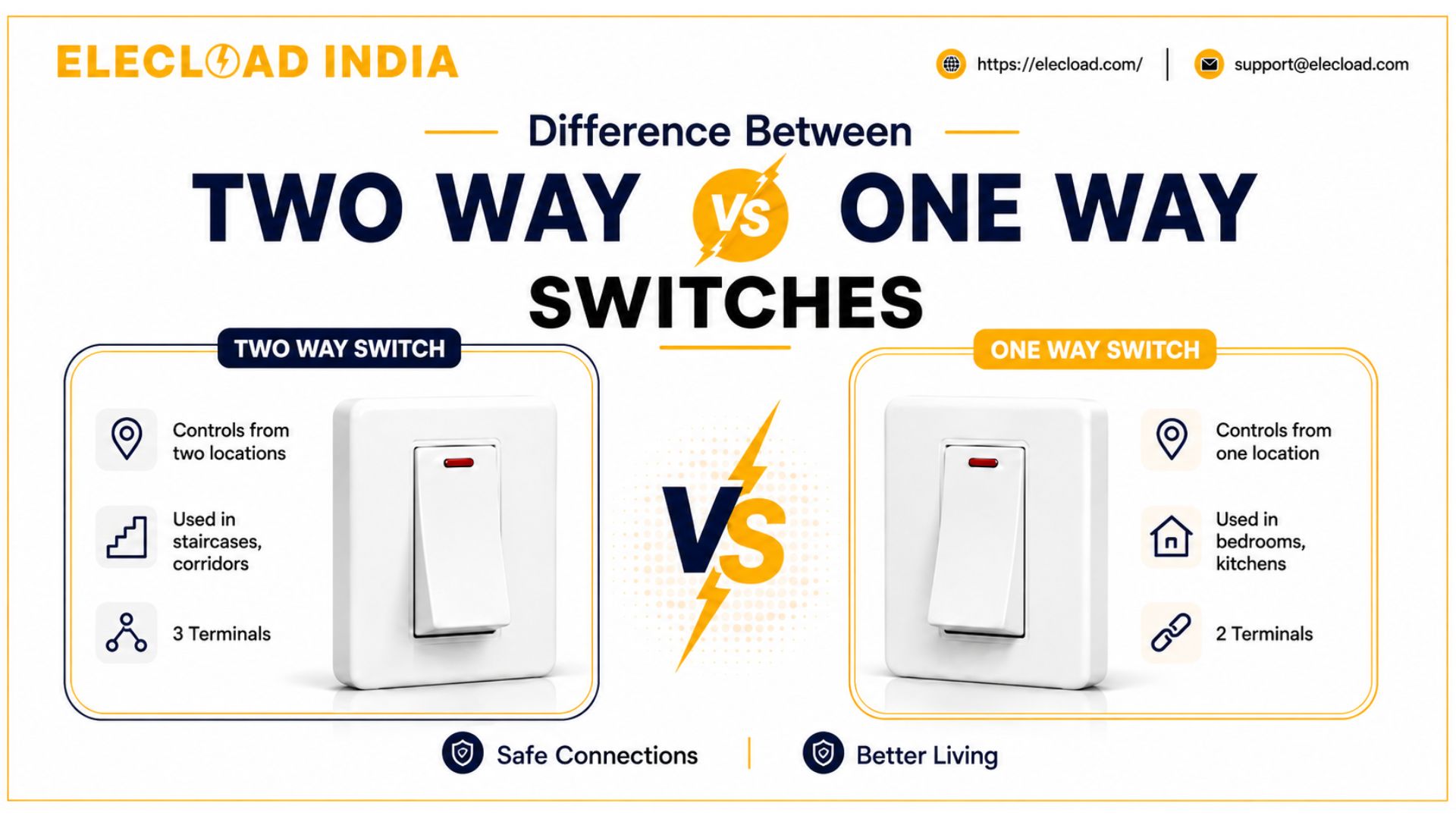
Difference Between Two Way vs One Way Switches
Walk through a typical Indian home, and you will find two very different kinds of switches doing two very different jobs. A bedroom light switch by the door is usually a simple on and off control. A staircase light, on the other hand, often has two switches, one at the bottom and one at the top, both able to turn the same light on or off. The first is a one way switches. The second is part of a two way switch circuit. Knowing this difference matters whether you are planning a new home, renovating an old one, or simply trying to fix a light that will not turn off properly.
At Elecload India, founded by Bhavin Joshi and operating from Mumbai since 2019, we stock a complete range of one way switches, two way switches, and modular switches from brands like Anchor, Legrand, GM Modular, Goldmedal, and Greatwhite. This guide draws on that hands on product experience to give you a clear, practical answer.
What is a One Way Switch?
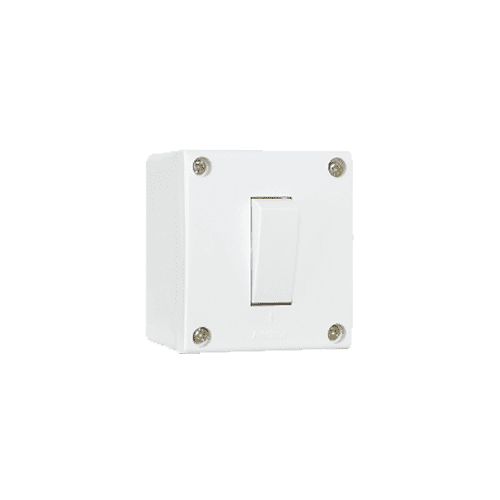
A one way switch is the most basic type of electrical switch used in Indian homes. It has a single control point, meaning the light or appliance connected to it can only be switched on or off from that one location. Flip it up, the circuit closes, and the light comes on. Flip it down, the circuit opens, and the light goes off.
Internally, it has just two terminals. One terminal connects to the incoming live wire from the distribution board, and the other connects to the outgoing wire that feeds the light point. There is no complexity in the wiring because there is only one switch controlling the circuit.
This simplicity is exactly why one way switches are used so widely. Bedroom lights, fan points, kitchen lighting, and individual socket circuits in most rooms only need to be controlled from a single location, so this switch type is both sufficient and the most cost effective choice.
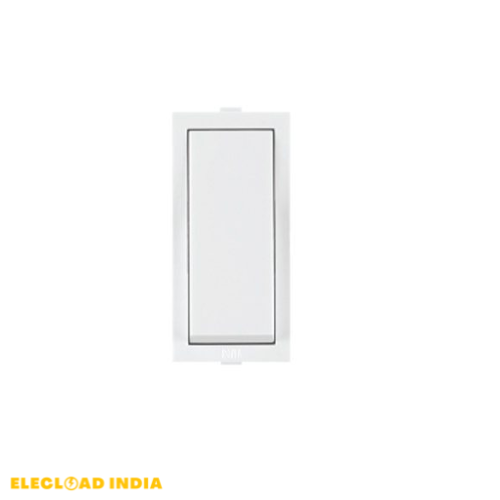
At Elecload India, the 1 module switch range from Legrand, Anchor, and GM Modular covers exactly this need, offering reliable single point control for everyday lighting and socket circuits.
What is a Two Way Switch?
A two way switch allows the same light or appliance to be controlled from two separate locations. This is the switch you find at both ends of a staircase, at both entrances of a long corridor, or in a bedroom where one switch sits near the door, and another sits beside the bed.
Its defining feature is that it has three terminals instead of two. These three terminals are typically marked as common, L1, and L2. A pair of these switches is wired together using two wires running between them, known as strapping wires, while the common terminal of each switch connects to the live supply on one end and the light point on the other.
This wiring arrangement allows either switch to change the state of the circuit independently. If the light is off and you flip either one, it turns on. If it is on, flipping either one turns it off, regardless of which switch was used last. This is what makes the staircase scenario work so smoothly. You turn the light on at the bottom of the stairs, walk up, and turn it off at the top using a completely different control point.
Key Differences Between One Way and Two Way Switches
The difference goes beyond just the number of control points. Understanding each distinction helps you choose correctly for every circuit in your home.
| Feature | One Way Switch | Two Way Switch |
|---|---|---|
| Number of Control Points | Controls a circuit from exactly one location | Controls the same circuit from two separate locations, with both switches able to independently change the state of the light |
| Terminal Count | Two terminals, an input and an output | Three terminals, common, L1, and L2, allowing it to be paired with a matching unit elsewhere in the circuit |
| Wiring Complexity | Straightforward wiring, requiring just a live wire in and a wire out to the load | Requires an additional pair of strapping wires running between the two switch locations, making installation slightly more involved |
| Cost | Generally less expensive, both in switch hardware and wiring | Costs more due to a paired setup and the additional strapping wire connection |
| Use Case | Right choice for any light or appliance that only needs to be controlled from one spot | Right choice when a light needs to be turned on from one location and off from another, common in staircases, long hallways and large bedrooms |
Where to Use One Way Switches in Your Home
One way switches cover the vast majority of lighting and socket points in a typical Indian home. Bedroom main lights controlled from a single door point, fan regulators in any room with one entry point, kitchen lighting where a single switch near the entrance is sufficient, and individual socket outlets across the home are all well served by this switch type.
For most rooms with a single entry door, there is simply no practical benefit to installing the two point version, since nobody needs to control the light from a second location. Sticking with the simpler option in these cases keeps both the cost and the wiring complexity lower without sacrificing any convenience.
Where to Use Two Way Switches in Your Home
Two way switches are specifically valuable wherever a light point needs control from two physically separate locations. Staircases are the most classic example. A person climbing the stairs can switch the light on at the bottom and off at the top, avoiding the need to walk back down or leave the light on unnecessarily. Long corridors in larger homes or offices benefit the same way, with a switch at each end allowing control without walking the full length of the passage.
Master bedrooms with two entry points, or where one switch is placed near the door and another beside the bed, are increasingly common in modern Indian homes. This setup lets a person turn off the room light from bed after entering through the door switch, adding a genuine convenience that a single control point cannot offer.
Some homeowners also use this dual control arrangement for garden or porch lights that need to be controlled from both an indoor point and an outdoor point near the gate.
How Two Way Switch Wiring Actually Works
Understanding the basic wiring helps when discussing requirements with an electrician or troubleshooting an existing installation.
In a typical two way switch circuit, the live supply connects to the common terminal of the first switch. Two wires, commonly called strapping or traveller wires, run from the L1 and L2 terminals of the first switch to the corresponding L1 and L2 terminals of the second switch. The common terminal of the second switch then connects onward to the light point, with the neutral wire completing the circuit back to the distribution board.
This three wire arrangement between the two switches is what allows either one to flip the state of the circuit, since the live connection effectively gets routed through whichever path is currently closed at each point.
For electricians planning this wiring, running the conduit and the additional strapping wire correctly during the rough wiring stage is far easier than trying to retrofit a dual control circuit after walls are finished. If you are planning new wiring or a renovation, decide on switch placement at the planning stage, before the PVC conduits are laid and concealed inside the walls.
Choosing the Right Switch Type for Your Project
When planning a new home or renovation, walk through each room and ask a simple question. Does this light or socket ever need to be controlled from more than one location? If the answer is no, a standard one way switch is the correct, cost effective choice. If the answer is yes, plan for a two way switch at both control points along with the extra strapping wire needed between them.
Most Indian homes use a mix of both. A typical 2BHK apartment might use single-point switches for the kitchen, individual bedroom lights, and most sockets, while reserving the dual-control type for the staircase if the home has one, and possibly for the main bedroom.
Modern modular switches make this planning easier than older switch designs, since modular plates allow you to mix one way, two way, and socket modules within the same plate, giving a clean and flexible final look on the wall regardless of how many control points a particular room needs.
Building the Complete Circuit: From Distribution Board to Switch
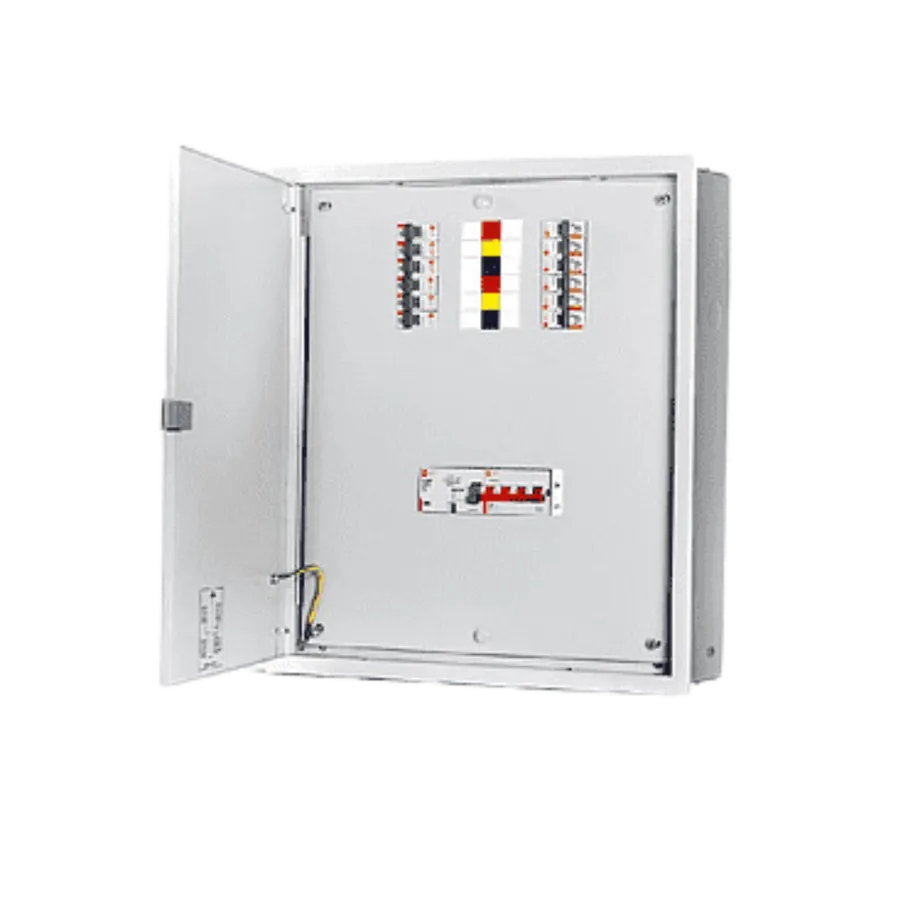
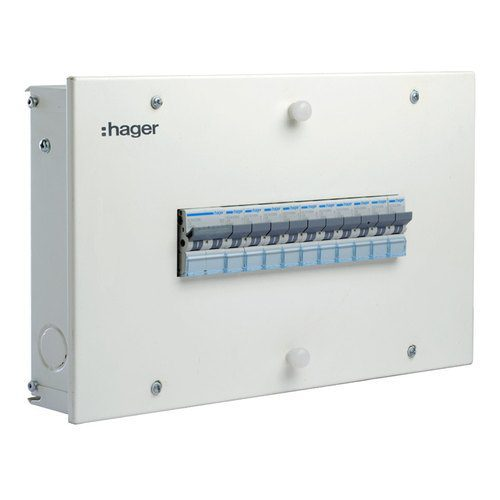
A switch, whether single point or dual point, is only the final point in a chain of correctly installed components. The circuit begins at the SPN distribution board, where an MCB protects the individual lighting or socket circuit feeding that room. From the distribution board, wiring runs through properly sized PVC conduits concealed in the wall, passing through a conduit junction box wherever the circuit branches, before finally reaching the switch point itself.
For homes with a single phase electrical connection, an SPN distribution board is the correct choice to feed all these lighting and switch circuits, with individual MCBs protecting each circuit independently. Getting this upstream wiring correct is just as important as choosing the right switch type, since the switch can only perform reliably if the circuit feeding it has been planned and installed correctly from the distribution board onward.
Best Brands for One Way and Two Way Switches in India
Quality matters significantly when it comes to switches, since they are operated dozens of times a day for years. A poorly made unit can develop a loose contact, leading to flickering, sparking, or eventual failure.
Anchor by Panasonic is one of the most widely trusted names for modular switches in India, offering both switch types across multiple ranges suited to different budgets and finishes. Legrand brings a premium European design sensibility with ranges like Myrius, offering smooth tactile operation and a refined finish across the board. GM Modular and Goldmedal are well established Indian brands offering reliable performance at competitive prices, with wide availability of both one way switches and two way switches in standard ampere ratings. Greatwhite has built a strong reputation for modern designs and consistent quality across its switch and socket range.
All of these brands are available at Elecload India with genuine product assurance, manufacturer warranty, and fast delivery across India.
Conclusion
Choosing between a one way switch and a two way switch comes down to one simple question: does the light or appliance need to be controlled from one location or two? For the vast majority of rooms in an Indian home, a standard one way switch is the correct, economical choice. For staircases, long corridors, and bedrooms with multiple entry points, a two way switch setup adds genuine everyday convenience that is well worth the small additional cost and wiring effort.
Whatever combination your home needs, the switch is only as reliable as the circuit behind it. Quality PVC conduits, a properly sized SPN distribution board, and correctly installed modular switches all work together to give you a wiring system that performs safely for years.
At Elecload India, the complete range of one way switches, two way switches, modular switches, and distribution boards from trusted Indian and international brands is available online with genuine quality assurance and pan India delivery.
Browse the Complete Switches and Sockets Range at Elecload India
Frequently Asked Questions
Q1. What is the main difference between a one way switch and a two way switch?
A one way switch controls a light or appliance from a single location and has two terminals. A two way switch controls the same circuit from two separate locations and has three terminals, allowing either switch to turn the connected light on or off independently.
Q2. Can I convert a one way switch circuit into a two way switch circuit?
Yes, but it requires additional wiring. You will need to replace the existing one way switch with a two way switch, install a second two way switch at the new control location, and run an additional pair of strapping wires between the two switches through a conduit. This is much easier to plan before walls are finished rather than after.
Q3. Where should I use a two way switch instead of a one way switch?
Use a two way switch wherever a light needs to be controlled from two separate physical locations, most commonly staircases, long corridors, and bedrooms with two entry points or a switch placed near both the door and the bed.
Q4. How many terminals does a two way switch have compared to a one way switch?
A one way switch has two terminals. A two way switch has three terminals, typically labelled common, L1, and L2, which allows it to be wired together with a second two way switch elsewhere in the circuit.
Q5. Is a two way switch more expensive than a one way switch?
Yes, generally. A two way switch circuit requires two switches instead of one, along with extra strapping wire, so the total cost of materials and installation is higher than a simple one way switch setup serving the same light point.
Q6. Do I need a conduit junction box for two way switch wiring?
Yes. Any point where the strapping wires branch or where the circuit needs to be joined should pass through a proper conduit junction box rather than having joints made directly inside the conduit, ensuring the connections remain accessible for future inspection or repair.
Q7. What type of distribution board do I need for home switch circuits?
For most Indian homes running on a single phase connection, an SPN distribution board is the standard choice. It houses the main incomer along with individual MCBs protecting each lighting and socket circuit that eventually feeds your one way switches and two way switches.
Q8. Can one way switches and two way switches be mixed on the same modular plate?
Yes. Modern modular switches are designed so that one way, two way, and socket modules can all be combined on a single plate. This is common in bedrooms where a main light might use a two way switch module alongside a separate one way switch module for a side lamp or fan.
Q9. Which brands offer the best one way and two way switches in India?
Anchor, Legrand, GM Modular, Goldmedal, and Greatwhite are among the most trusted brands for both one way switches and two way switches in India, each offering a range of finishes and ampere ratings suited to residential and commercial use. All of these are available at Elecload India.
Q10. Where can I buy genuine one way and two way switches online in India?
You can shop genuine one way switches, two way switches, and the full range of modular switches from Anchor, Legrand, GM Modular, Goldmedal, and Greatwhite at Elecload India, elecload.com. Established in 2019 and operated by Bhavin Joshi from Mumbai, Elecload India offers 100% genuine products, manufacturer warranty, secure online payment, and fast delivery across India. Call 9321025013 for product queries and bulk pricing.
Shop One Way and Two Way Switches at Elecload India
Published by Elecload India | Founded by Bhavin Joshi | Shop no. 31A, Khajuria Nagar, Khajuria Tank Road, Near Bhadran Nagar, Kandivali West, Mumbai, Maharashtra 400067 | Phone: 9321025013 | Category: Switches and Sockets | Last Updated: June 2026